
Affiliate Internal Linking Strategy: Boost Rankings and Conversions
Ever wondered why some sites top Google while others with great content struggle? The answer often lies in their internal links. A smart affiliate internal linking strategy does more than guide visitors.
These links are like a digital map for search engines. They help bots explore your site quickly. They also show which pages are most valuable. By linking to your top reviews, you can significantly increase your earnings.
Mastering this strategy can greatly improve your rankings. Strong links build trust with readers and search algorithms. This guide shows how to turn your site into a powerful, high-converting machine.
Table of Contents
Key Takeaways
- Enhance search engine visibility through better crawling.
- Drive more traffic to your highest-converting pages.
- Strengthen your website’s topical authority and trust.
- Lower bounce rates by keeping users engaged longer.
- Distribute page authority effectively across your domain.
- Simplify the user journey toward making a purchase.
1. Why Internal Linking Matters for Affiliate Site Success
Internal linking is key for affiliate marketers wanting to boost their site’s earnings. It helps search engines find your site and spreads PageRank to your best pages. It also makes your site easy to navigate and guides visitors to buy.
The Revenue Impact of Strategic Internal Links
Good internal linking can really help your affiliate site make more money. It directs visitors to pages that are likely to convert. This makes your site’s important content more visible.
- It makes the site more useful by adding extra valuable info
- It keeps visitors on your site longer, which lowers bounce rates
- It helps guide visitors from first interest to making a purchase
How Search Engines Evaluate Affiliate Site Authority
Search engines look at many things when deciding how trustworthy an affiliate site is. A good internal linking plan helps them see your site’s structure and what it’s about. This makes your site seem more authoritative.
- It makes your content’s order clear
- It uses clear and descriptive link text
- It avoids too many links and makes sure they’re relevant
By using these tactics, affiliate marketers can make their sites more credible. This can help them rank better in search results.
User Experience and Navigation Benefits
Internal linking is good for SEO, but it also makes your site better for users. It gives visitors links to more content they might like. This can lead to more engagement and sales.
- It keeps visitors interested and lowers bounce rates
- It helps users find more products or info, which can lead to more sales
- It makes your site easier to get around
By focusing on these areas, affiliate marketers can make their sites more enjoyable. This can lead to more sales and revenue.
2. Building a Content Hierarchy That Maximizes Link Value
To boost link value, affiliate marketers need a clear content hierarchy. This structure should be logical and grow with your site. A good plan ensures you use every link wisely.
Start by organizing your site’s structure. Identify key pages, or pillar pages, and group related content into topic clusters. Use authority pages to share link value and support new content with links.
Choose the right anchor text and add links that help users navigate and find related content. These steps are essential for maximizing link value.
Hub and Spoke Model for Affiliate Websites
The Hub and Spoke model is great for affiliate sites. It has a central “hub” page that covers a wide topic. This page links to “spoke” pages that dive into subtopics.
This model boosts your site’s authority and SEO. For example, a fitness equipment site might have a hub page on home gyms. Spoke pages could review specific products like treadmills or dumbbells.
This setup is perfect for link building for affiliates by linking content together.
Tiered Content Structure for SEO Power
A tiered content structure is also effective. It categorizes content by importance and relevance. The top tier has high-value pages like product reviews or buying guides.
Lower tiers have support content like blog posts or informational articles. This structure helps distribute link equity and boosts your site’s SEO.
- Tier 1: High-value pages (product reviews, buying guides)
- Tier 2: Support content (blog posts, informational articles)
- Tier 3: Long-tail content (specific product comparisons, niche topics)
Identifying Your Money Pages and Support Content
It’s key to know your “money pages” and support content. Money pages make money, like product review pages. Support content adds value and helps your money pages.
Understanding each content’s role helps you link better. This improves traffic to your money pages and boosts conversions. Use relevant anchor text to link from support content to money pages.
For example, a buying guide can link to product reviews. This enhances the user experience and increases conversion chances.
3. Implementing the Affiliate Internal Linking Strategy Across Your Site
A strong internal linking structure is key for a successful affiliate site. It boosts user engagement and search rankings. Having a clear plan is essential.
Creating Your Internal Linking Blueprint
Start by mapping your website’s content. Identify key pages like product reviews and comparisons. Use tools like Screaming Frog or Ahrefs to see your site’s structure and find areas to improve.
When making your blueprint, remember:
- Link top content to relevant pages.
- Group similar content together.
- Make sure important pages are no more than three clicks from the homepage.
Link Distribution Best Practices
Effective link distribution is vital for SEO. Aim to spread links evenly across your site.
Best practices include:
- Don’t put too many links on one page.
- Use a mix of exact and partial match anchor text.
- Avoid linking too much to one page.
Balancing Link Equity Flow to Conversion Pages
To boost conversions, make sure conversion pages get enough link equity. Link to them from relevant, high-authority pages.
Consider these strategies:
- Link to conversion pages from related content clusters.
- Use contextual linking in your content.
- Make sure conversion pages are easy to find from your main navigation.
Audit Your Current Internal Link Structure
To find areas for improvement, audit your internal links with tools like Semrush Site Audit. Look for common issues like:
- Broken internal links.
- Orphaned pages.
- Pages with too many or too few internal links.
- Internal redirect chains and loops.
Fixing these issues and having a solid internal linking strategy can greatly improve your site’s SEO and conversions.
4. Anchor Text Optimization for Affiliate SEO
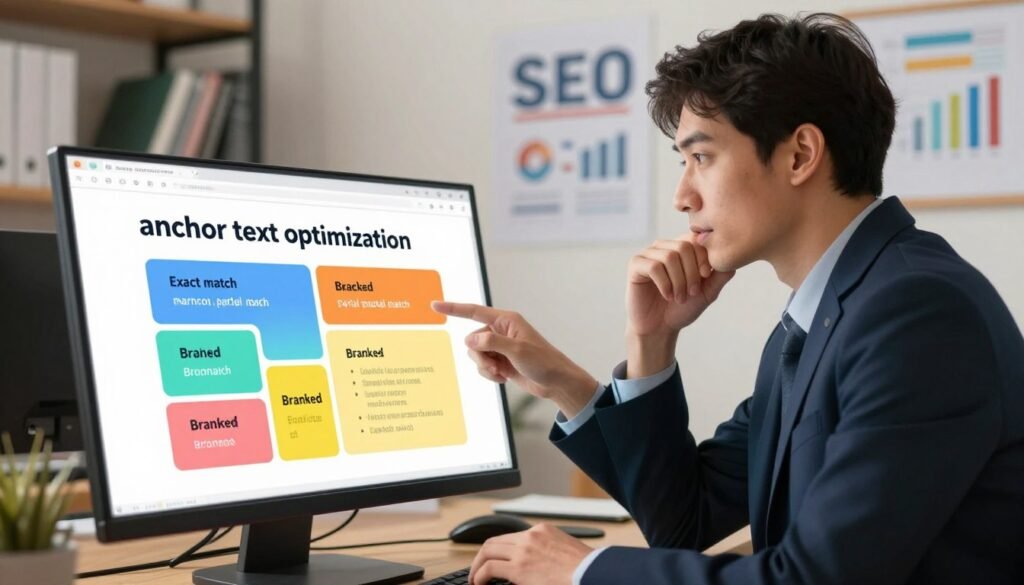
Optimizing anchor text is key for affiliate SEO success. It helps search engines understand the relevance of linked pages. Good internal linking strategies use well-crafted anchor text to guide users and search engines.
Anchor text tells search engines about the linked page’s content. It should be clear, short, and match the page’s topic. The right anchor text boosts internal link SEO, leading to better rankings and easier navigation.
Exact Match vs. Partial Match Anchor Strategies
Choosing between exact match and partial match keywords is important. Exact match anchor text uses the target keyword exactly as it appears. For example, “best running shoes” would be used for a page about the best running shoes.
Partial match anchor text includes variations of the target keyword. For instance, “top-rated running shoes” or “best shoes for running” are partial matches. This method creates a more natural link profile.
- Exact match anchor text is good for specific product pages or competitive keywords.
- Partial match anchor text helps avoid over-optimization by adding diversity.
Branded and Natural Anchor Text Variations
Using branded and natural anchor text variations is also important. Branded anchor text uses the brand name to strengthen brand identity and authority.
Natural anchor text includes generic phrases like “click here” or “visit our guide.” These add diversity and make links seem more natural.
- Branded anchor text promotes brand recognition and authority.
- Natural anchor text maintains a natural link profile.
Avoiding Over-Optimization Penalties
Avoiding over-optimization is critical. Search engines penalize sites that use too much exact match anchor text. It looks like manipulation.
To avoid penalties, have a diverse anchor text profile. Mix exact match, partial match, branded, and natural anchor text. This shows search engines the linking is natural.
By following these tips and balancing anchor text optimization, affiliate marketers can improve their site’s SEO. This leads to better user experience and more conversions.
5. Contextual Linking Strategies That Drive Conversions
Affiliate marketers need to use linking strategies that feel natural to their audience. They should know where and how to place links in content. This helps guide users through their buying journey.
Strategic Placement Within Content Body
Where you place links is more important than how many you have. A few well-placed links are better than many generic ones. Links should fit naturally in paragraphs where they add value.
For example, in a review of hiking gear, link to a backpack model when discussing its features. This makes the link relevant and useful.
Effective link placement means understanding your content’s flow. Find points where users are likely to want more information or a specific product. This could be in detailed comparisons or when discussing benefits.
Linking from High-Engagement Sections
Finding high-engagement sections in your content is key. These areas get more user time or interest. Examples include detailed reviews, comparison charts, or tutorials.
Linking from these sections can capitalize on user interest. For example, linking to camera reviews at the end of a tutorial can be very effective. It guides users to make a purchase based on their current interest.
Pre-Selling Content to Product Reviews
Pre-selling content, like guides or articles, is vital in the buyer’s journey. Linking from this content to product reviews or sales pages helps users transition from learning to buying.
An example is linking from an article on ergonomic furniture to reviews of top ergonomic chairs. This makes the transition smooth for users.
Creating Natural Link Opportunities in Comparisons
Comparisons are a natural fit for links, as they discuss different products’ pros and cons. Linking to detailed reviews or product pages from comparisons helps users make informed decisions.
To illustrate, a comparison between smartphones could link to review pages for each model. This allows users to explore each device’s specifics.
By using these contextual linking strategies, affiliate marketers can boost their internal linking’s effectiveness. This drives user engagement and conversions.
6. Leveraging Comparison and Alternative Content for Link Power

Using comparison and alternative content is a smart way to boost your site’s internal linking. This approach helps improve user experience and search rankings. By linking to comparison pages, best alternative articles, and versus content, you can make your site more valuable.
Comparison Pages as Internal Link Hubs
Comparison pages are great for linking other content on your site. They attract links from product reviews and guides. This makes your site’s structure stronger and boosts the authority of related pages.
To make comparison pages work best, make sure they are:
- Informative and detailed
- Regularly updated with fresh content
- Interlinked with relevant product reviews and guides
Best Alternative Articles Strategy
Writing “best alternative” articles is another smart move. These articles offer users other options or products, making their experience better. By linking these articles to product reviews or comparison pages, you create a smooth path for users.
For example, an article on the “best alternative to [product]” can link to a review of the original product. This creates a contextual link that adds value to the user.
Versus Content for Targeted Link Building
“Versus” content, which compares products or services directly, is great for attracting links. By creating versus content, you can draw links from users and other websites. This type of content works well when linked from high-authority sites or social media.
To maximize versus content, ensure it is:
- Objective and unbiased
- Rich in relevant keywords
- Linked to relevant product categories or reviews
For more tips on improving your internal linking, check out Affiliate Haven’s Tools page. It has lots of resources and tools to help your affiliate marketing.
7. Topical Relevance and Semantic Linking Techniques
In affiliate marketing, making your site relevant and linked is key. It makes your site better for users and boosts your search rankings. This shows your site is an expert on certain topics.
Google looks at your site as a whole, not just pages. Topical relevance and semantic linking help connect your content. This guides users and search engines through your site.
Connecting Related Product Categories
Linking related product categories is a smart move. It makes your site easy to navigate. For example, an outdoor gear site could link “Camping Equipment” to “Best Camping Stoves” or “Top Tents for Beginners.”
Buyer’s Guides to Individual Product Reviews
Use buyer’s guides to link to product reviews. These guides offer detailed info and comparisons. They help users and search engines find what they need.
For instance, a guide on “The Best Smartwatches for Fitness” could link to reviews of top models. This creates a network of related content that search engines can index well.
Building Topical Authority Through Link Clusters
Link clusters help build your site’s authority. Group related content and link it together. This could be around a product category, with links to reviews, comparisons, and guides.
This signals to search engines that your site is a go-to for that topic. It can improve your site’s rankings and visibility.
8. Reducing Bounce Rate with Strategic Internal Links
By using a smart internal linking strategy, affiliate marketers can make their sites better for users. This approach keeps visitors on the site longer. It also boosts the chances of them making a purchase.
Related Content Modules That Keep Users Engaged
One great way to lower bounce rates is by adding related content modules. These can be “You Might Also Like” or “Related Products” sections. They guide users to other useful content on your site.
For instance, if you’re reviewing a product, link to similar reviews or a comparison page. This makes the user experience better and encourages them to see more of your content.
Table of Contents Navigation for Long-Form Content
For long articles, like detailed guides or tutorials, a table of contents is a big help. It lets users quickly find the parts they’re most interested in. This cuts down on frustration and bouncing.
A table of contents also helps search engines understand your content better. This can make your content more visible in search results.
End-of-Article Link Recommendations
Another smart move is to suggest links at the end of your articles. You can have a “Next Steps” or “Further Reading” section. This directs users to the next relevant piece of content.
By giving users a clear path, you keep them engaged. This reduces the chance of them leaving your site without checking out more.
Key Takeaways:
- Use related content modules to keep users engaged.
- Implement table of contents navigation for long-form content.
- Include end-of-article link recommendations to guide users further.
9. Seasonal Content and Link Velocity Tactics
Effective affiliate marketing needs a deep understanding of seasonal content and link velocity. These elements can boost your site’s performance and visibility. By using timely content and smart linking, you can make your site more relevant and visible.
Linking Holiday Deals to Evergreen Reviews
Linking holiday deals to evergreen reviews is a smart strategy. It uses seasonal trends and highlights the value of timeless content. For example, during Black Friday, linking deals to detailed reviews can improve user experience and boost sales.
To do this, pick your best evergreen content and create seasonal pages or promotions. These should link back to your authoritative reviews. This internal linking strategy spreads link equity and keeps users engaged.
Updating Old Posts with Fresh Internal Links
Refreshing old posts with new internal links is key. It makes older content relevant again and boosts its search engine ranking. You need to find outdated links and add new ones to recent, relevant content.
For example, if you have an old review of a product that’s been updated, link to the new review. This helps users find the latest info and helps search engines understand your site’s structure.
Time-Sensitive Link Opportunities
Grabbing time-sensitive link opportunities is vital for a dynamic site. Create content around timely events, trends, or product launches. Then, link it to relevant content on your site.
For instance, during a big product launch, make a “top products” list that links to detailed reviews. This drives traffic and improves user experience. Make sure to link this time-sensitive content back to evergreen content for maximum impact.
| Strategy | Description | Benefits |
|---|---|---|
| Linking Holiday Deals to Evergreen Reviews | Connect seasonal promotions to timeless product reviews. | Improves user experience, increases conversion rates. |
| Updating Old Posts | Refresh older content with new internal links. | Reinvigorates content relevance, improves SEO. |
| Time-Sensitive Link Opportunities | Create content around timely events and link to relevant existing content. | Drives traffic, enhances user experience. |
By using these strategies, you can make your affiliate website more dynamic and user-friendly. For more tips on affiliate marketing, check out Affiliates Haven for detailed resources and advice.
10. Avoiding Critical Internal Linking Mistakes

Effective internal linking is key to affiliate SEO. Yet, many sites make mistakes that hurt their link equity. A good internal linking strategy can boost user experience, improve search rankings, and increase conversions. But, common errors can waste this opportunity and lower site performance.
Orphaned Pages That Waste Their Worth
Orphaned pages are not linked from any other page. They’re invisible to users and search engines, wasting their chance to attract visitors and conversions. It’s vital to link every page from another to avoid this.
Best Practice: Check your site often to find and link to orphaned pages. Use Google Search Console to find pages not crawled or indexed.
Link Depth Issues Affecting Rankings
Link depth is how many clicks it takes to reach a page from the homepage. Pages far from the homepage may not be seen as much. Make sure important pages are close to the homepage.
Example: An e-commerce site with deep categories might use breadcrumb navigation and category pages to shorten link depth for product pages.
Too Many Links Diluting Authority
Internal linking is good, but too much can weaken the authority of each page. Too many links on one page can also confuse users. It’s important to find a balance between useful links and not too many.
| Page Type | Recommended Link Count | User Benefit |
|---|---|---|
| Category Page | 5-10 links | Helps users navigate to relevant subcategories or products |
| Product Review | 3-5 links | Directs users to related products, comparisons, or buying guides |
| Blog Post | 2-4 links | Enhances user experience by linking to related content or deeper dives |
Broken Internal Links and Redirect Chains
Broken internal links and redirect chains can harm user experience and search rankings. Broken links cause “404 Not Found” errors, which can lose users. Redirect chains slow down pages and weaken link equity.
Solution: Use tools like Ahrefs or SEMrush to find broken links and fix them quickly. Simplify redirect chains by linking directly to the final page.
11. Measuring and Tracking Internal Link Performance
To make your affiliate internal linking strategy better, you need to check its performance often. Use different tools and methods to see how internal links help your site. This will help you understand their role in your site’s success.
Google Analytics Internal Link Reports
Google Analytics gives you key insights into how users use your site’s internal links. The behavior flow report shows which links are best at guiding users. This info helps you make your internal linking better, boosting user engagement and sales.
To track internal links in Google Analytics, use the Behavior Flow report. It shows how users move through your site, pointing out where they stop. By looking at this data, you can spot areas to improve your internal linking.
Google Search Console Data for Link Analysis
Google Search Console is also great for checking internal link performance. It shows how search engines see your site, including your internal links. The Links report in Google Search Console tells you which pages get the most links and how they do in search results.
Conversion Path Attribution
It’s important to know how internal links help with conversions. Conversion path attribution lets you see how users move before making a purchase. This way, you can find out which links are best at making money.
Google Analytics can help with conversion path analysis. It shows the path users take before buying, helping you see which links are most effective. This info helps you make your internal linking better, increasing sales and ROI.
Heatmaps and User Behavior Tracking
Heatmaps and user behavior tools give you a visual look at how users interact with your site’s links. Heatmaps show which links get clicked the most and how users move through your content. This helps you find ways to make your internal linking better and improve user experience.
Tools like Crazy Egg or Hotjar offer heatmap analysis. They let you see how users behave and adjust your internal links based on that. By combining heatmap data with other analytics, you get a full picture of your internal link performance. This helps you make smart choices to improve your affiliate internal linking strategy.
12. Conclusion
Effective internal linking is key for affiliate site success. It’s a mix of technical SEO and user-friendly design. By avoiding common mistakes and using the right tools, affiliates can create a strong site. This site will help drive sales and improve rankings.
Using internal linking best practices is vital. It helps increase link value, makes navigation easier, and boosts site authority. This means creating a clear content structure, using the right anchor text, and linking content in a way that guides users to what they need.
By focusing on these strategies and keeping an eye on link performance, affiliates can get better results. This leads to a site that’s easy to use and improves search rankings. It also helps increase revenue.