
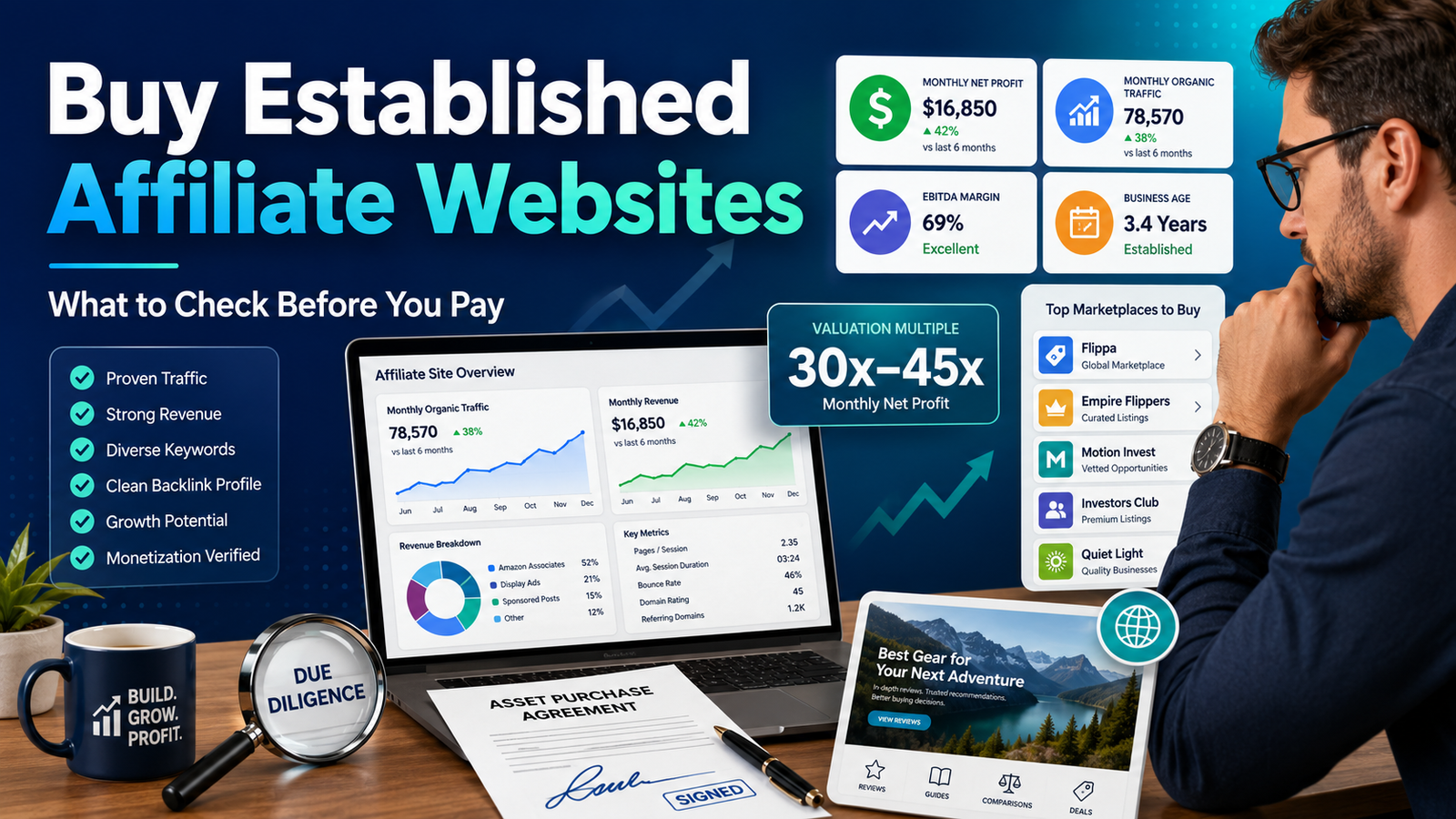
Best Places to Buy Established Affiliate Websites in 2026 (and What to Actually Check Before You Pay)
Disclosure: Some links on this page may be affiliate links. If you buy through them, I may earn a commission at no extra cost to you. I only recommend what I’d use myself. Read the full disclosure.
If you’re looking to buy established affiliate websites instead of building from scratch, you’re skipping months of content grinding and jumping straight into a revenue-generating asset. Affiliate websites typically sell for 30x to 45x monthly net profit, which means a site earning $1,000/month could cost you anywhere from $30,000 to $45,000. That multiple matters. It shapes everything from your ROI timeline to your negotiating position, and most buyers walk in without knowing it.
Key Takeaways
| Question | Quick Answer |
|---|---|
| Why buy an established affiliate website? | You acquire existing traffic, content, and revenue instead of building the asset from zero. It compresses your path to positive cash flow. |
| Where do most people buy established affiliate websites? | Flippa, Empire Flippers, Motion Invest, and Investors Club are the main active marketplaces in 2026. |
| What multiple should I expect to pay? | 30x to 45x monthly net profit is the current benchmark. Quality content sites with diversified revenue trend toward the higher end. |
| What’s the biggest due diligence mistake buyers make? | Skipping traffic source verification and trusting revenue screenshots without cross-referencing analytics and network dashboards. |
| Is buying an affiliate site better than building one? | Depends on capital and timeline. Buying is faster to revenue. Building is cheaper upfront. See our start here guide if you’re still deciding. |
| What makes an affiliate site a “good” buy? | Diversified traffic sources, multiple revenue streams, clean compliance history, and content that functions as a living asset rather than a dated post dump. |
| Should beginners buy established affiliate websites? | Possibly. But only if you understand the operational layer first. Review our affiliate marketing beginners section before committing capital. |
Why Buy Established Affiliate Websites Instead of Building From Scratch
Building an affiliate site from zero is the playbook most people start with. It’s also the slowest path to revenue.
When you buy an established affiliate website, you’re acquiring a system that’s already running: existing content, existing traffic, existing commissions. The compounding work is already done.
Here’s what you’re actually buying:
- Compounding traffic: Content clusters that have been indexed and visited, not hypothetical future posts.
- Proven monetization: Real EPC data across real offers, not projections.
- Network relationships: Active affiliate program approvals that would take a new site months to earn.
- An audience signal: You know what the reader wants because the data already exists.
The tradeoff is capital. You’re paying a multiple for that head start.
The no-BS framing: buying a site is not a shortcut to easy money. It’s a different entry point into the same operating system. You still need to run it.
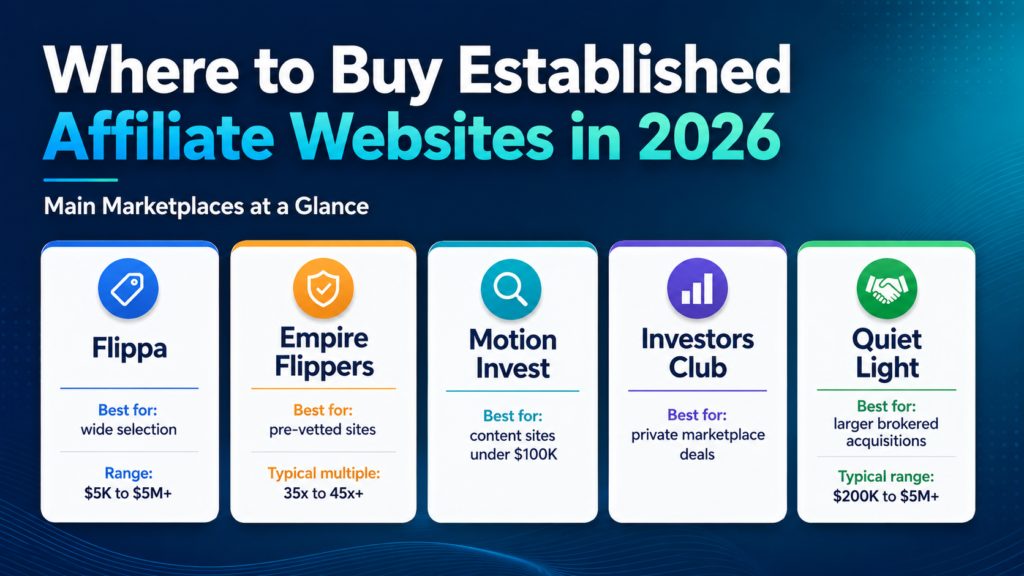
Where to Buy Established Affiliate Websites: The Main Marketplaces in 2026
Not all marketplaces are the same. Each one has a different buyer pool, vetting level, and deal size sweet spot.
Here’s the current stack worth knowing:
Flippa
Best for: Buyers willing to do their own diligence on a wide range of deal sizes ($5K to $5M+).
Flippa is the largest marketplace for buying and selling online businesses, including affiliate websites. Listing volume is high. So is variance in quality.
You’ll find genuine deals and inflated listings on the same page. That’s the environment. Flippa does offer a due diligence service, but buyers should treat it as a starting point, not a final answer.
- Buyer verification: available but not mandatory
- Deal structure: direct buyer-seller negotiation
- Typical multiples: 25x to 40x monthly profit per Flippa’s own content site data
Empire Flippers
Best for: Buyers who want pre-vetted listings and don’t want to sort through noise.
Empire Flippers is the most operator-friendly marketplace for mid-to-large affiliate sites. They reject a significant portion of submitted listings before they go live.
You pay a premium for that filter. Multiples tend to be higher here than on Flippa, but the revenue verification is more rigorous. Their migration process is also a key differentiator: they handle the actual site transfer, not just the paperwork.
- Minimum revenue: typically $500+/month verified
- Vetting: income and traffic independently reviewed
- Typical multiples: 35x to 45x+ for quality content sites
Motion Invest
Best for: Buyers looking at smaller affiliate content sites under $100K.
Motion Invest focuses specifically on content sites. If you want to buy established affiliate websites in the $5K to $100K range without the complexity of a large deal, this is the cleaner option.
They offer their own internal valuations and a starter package for buyers new to the acquisition process.
Investors Club
Best for: Privacy-focused buyers and sellers who prefer off-market deals.
Investors Club operates as a private marketplace with membership requirements on both sides. Less volume than Flippa, but deal quality is generally higher per listing.
Quiet Light Brokerage
Best for: Buyers targeting $200K to $5M+ established affiliate businesses.
Quiet Light uses a brokered model where experienced advisors represent sellers. If you’re acquiring a serious content asset with complex monetization architecture, this is the right environment.
How to Value an Established Affiliate Website Before You Buy
Valuation is where most buyers get burned. Not because they can’t math, but because they accept the seller’s math without building their own model.
The standard formula: Monthly Net Profit x Multiple = Asking Price.
That sounds simple. The complexity is in “net profit.” Sellers sometimes strip expenses, inflate trailing 12-month averages with anomalous months, or include one-time revenue spikes in their baseline.
Here’s the no-BS version of what to calculate:
- TTM revenue: Trailing 12-month average, not cherry-picked best months.
- Actual expenses: Hosting, content creation, tools, link building, VA costs. All of it.
- Net profit: Revenue minus all real operational costs.
- Multiple range: Apply the 30x to 45x benchmark to that number, not the seller’s number.
A site with clean, diversified revenue streams and stable 12-month traffic trends earns its 45x multiple. A single-program site with one traffic source is worth closer to 25x, if that.
Run the model both ways. Then negotiate from your number, not theirs.
For a grounding on what a well-structured affiliate monetization layer looks like, our emails and funnels section breaks down how EPC-focused architectures compound value over time.
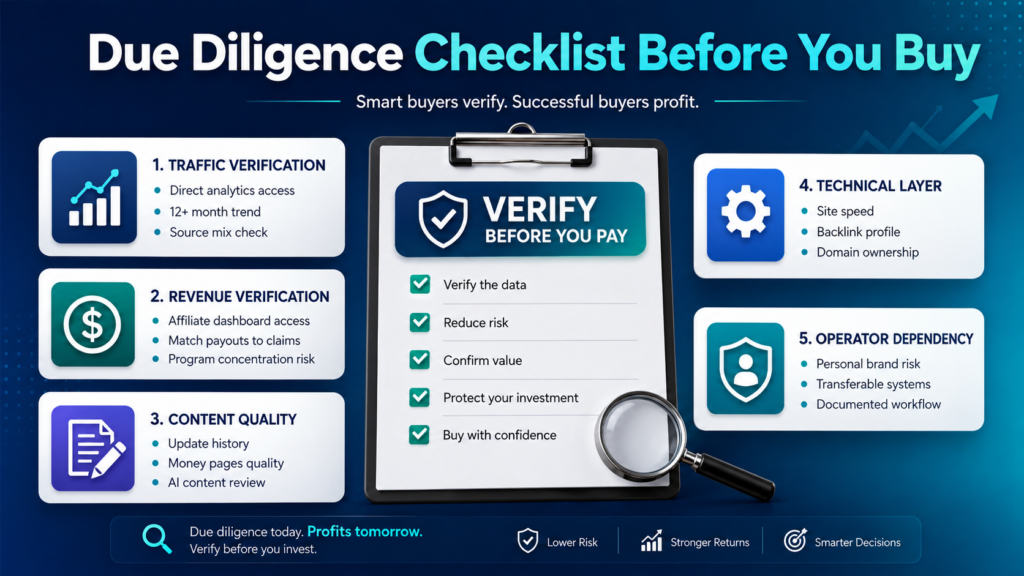
Due Diligence Checklist: What to Verify Before You Buy Established Affiliate Websites
Diligence is not optional. It’s the entire job on your side of the table.
Here’s the execution checklist, layer by layer:
Traffic Verification
- Request Google Analytics access (not screenshots).
- Verify traffic consistency over 12+ months, not just recent highs.
- Check traffic source distribution: organic, direct, referral, social. Heavy reliance on one source is platform roulette.
- Cross-reference with any available third-party estimates (Ahrefs, Semrush) to flag anomalies.
Revenue Verification
- Request direct access to affiliate network dashboards: Commission Junction, ShareASale, Amazon Associates, Impact, whatever they use.
- Match payment receipts to reported income.
- Identify which programs drive the majority of revenue, and assess what happens if one gets terminated.
- Check for any networks flagged in compliance reviews. Our networks and compliance section covers what to watch for.
Content Quality
- Is the content a living asset or a dated archive? Check post dates and update frequency.
- Are the money posts (top-performing revenue pages) recent enough to be trusted?
- Has the site used AI-generated content at scale? If so, what’s the quality tier and disclosure approach?
Technical Layer
- Check hosting infrastructure, site speed, and any outstanding technical debt.
- Review backlink profile for spammy or purchased links that could create future liability.
- Confirm domain ownership and any trademark considerations.
Operator Dependency
- How much does the site depend on the current owner’s personal brand or social presence?
- Is the content strategy documented and transferable?
- Can the operational system run without that specific person?
Red Flags When You Buy Established Affiliate Websites
Some patterns repeat across bad deals. Train yourself to recognize them fast.
- Revenue spike in the last 3 months: Seller timed the listing to maximize multiple. Dig into what caused it and whether it’s repeatable.
- Single-program dependency: If 80%+ of revenue comes from one affiliate program, that program terminating ends the income. No diversification means elevated risk, and the price should reflect that.
- No analytics access: Any seller who can’t or won’t provide direct analytics access is not a seller you want to proceed with.
- Thin content at scale: Large volumes of low-effort posts created purely for volume. This is a liability, not an asset, especially after content quality updates in 2026.
- Seller urgency without a credible explanation: Legitimate sellers have documented reasons for exiting. Vague urgency is a signal, not a coincidence.
- Unexplained traffic drops or gaps in historical data: These are not formatting anomalies. They’re events the seller may be hoping you overlook.
Best Types of Established Affiliate Websites to Buy in 2026
Not every category carries the same risk-to-return ratio. Here’s how to think about it by site type.
Review-Based Content Sites (Best for Beginners to Intermediate Buyers)
These sites publish product reviews, comparisons, and “best of” lists monetized through affiliate programs. They’re the most common type on the major marketplaces.
Strengths: predictable content architecture, well-understood monetization mechanics, transferable without personal brand dependency.
Risks: content quality updates can materially affect traffic. Always verify traffic stability over 18+ months, not just recent figures.
Niche Information Sites With Affiliate Monetization
Sites built around a specific problem set (health, finance, outdoor gear, software tools) with content that earns through contextual affiliate links rather than pure review posts.
These tend to have higher topical authority and more defensible traffic patterns. They’re also more complex to grow post-acquisition because the content layer requires genuine expertise.
Email-Integrated Affiliate Sites
Sites that have built an active email list alongside the content layer. The email asset is separate from the website but often transfers with it. If EPC on the list is documented and the list is engaged, you’re buying two revenue streams for the price of one listing.
This is where compounding traffic meets compounding conversions. It’s the highest-value structure when you can find it. See how this plays out in our email funnels section for the mechanics behind list-based monetization.
Pinterest-Driven Content Sites
Sites built with a content-plus-Pinterest traffic strategy, generating evergreen inbound clicks outside of purely organic channels. These tend to have more traffic source diversification baked in, which reduces platform roulette risk.
The caveat: Pinterest traffic requires ongoing pin maintenance. Factor that operational cost into your net profit calculation before applying a multiple.
Software or Tool-Adjacent Affiliate Sites
Sites that review SaaS products, marketing tools, or business software and earn through recurring affiliate commissions. These can carry higher EPC than physical product affiliates because SaaS commissions are often subscription-based.
The risk: SaaS product discontinuations or affiliate program terminations can drop revenue fast. Diversification across programs is the floor requirement here.
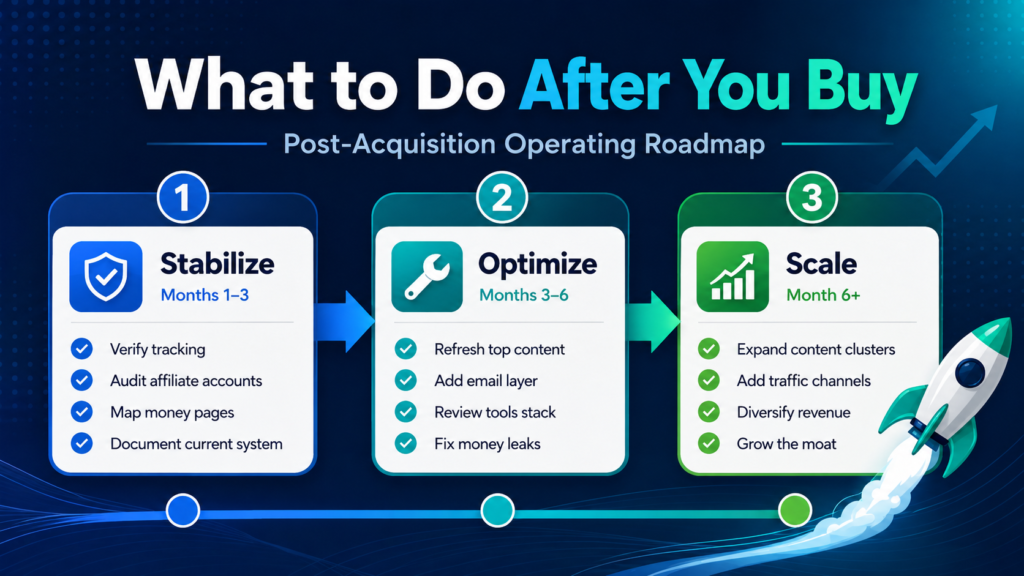
What to Do After You Buy an Established Affiliate Website
Acquisition day is day one of operations, not the finish line.
Most buyers underperform because they treat the purchase as the achievement. The site is a living asset. It requires an operator.
Here’s the repeatable post-acquisition system, broken into phases:
Phase 1: Stabilize (Months 1 to 3)
- Audit all affiliate program accounts and ensure clean transfer of all network relationships.
- Verify tracking is intact. Broken affiliate links are money leaks that often don’t surface until you look for them.
- Map the existing content architecture: which posts are the money posts, which are supporting content, which are dead weight.
- Document what the previous operator was doing. Don’t change anything until you understand it.
Phase 2: Optimize (Months 3 to 6)
- Update top-performing content. A living asset gets refreshed. Stale posts decay.
- Add or expand the email layer if one doesn’t exist. The site has an audience. Capture it.
- Review the tools stack. Tools should save time or make money. Cut anything that does neither.
- Check the tools section for a curated stack built around affiliate workflow efficiency.
Phase 3: Scale (Month 6 and Beyond)
- Expand the content cluster into adjacent subtopics the site hasn’t covered.
- Add traffic channels: the existing site likely runs on one or two. Adding Pinterest or an email sequence expands the moat.
- Introduce additional affiliate programs that match reader intent. Revenue diversification is not just a valuation metric. It’s a risk management move.
If you’re newer to operating these systems, the affiliate marketing foundations section covers the core mechanics in sequence before you start scaling.
Should Beginners Buy Established Affiliate Websites?
Honest answer: maybe, but with conditions.
Buying an established site does not eliminate the need to understand how the system works. If you can’t read a traffic report, evaluate a content cluster, or recognize a broken funnel, you won’t know when the asset is degrading until it’s already degraded.
The no-BS framing: capital without operator knowledge is expensive on the way in and painful on the way out.
The better sequence for most beginners:
- Understand how affiliate sites generate revenue at the mechanical level.
- Learn how content, traffic, and conversion interact as a system.
- Then evaluate acquisitions from a position of operational competence.
Our start here page walks through the full sequence before you commit capital to anything, including acquisitions.
If you already have operator experience and want to skip the build phase, buying an established affiliate website is a legitimate and often faster path to revenue outcomes. The key is approaching it like a systems engineer, not a lottery ticket buyer.
Conclusion
Buying established affiliate websites is one of the few moves in this industry where you can acquire revenue-generating infrastructure on day one instead of month twelve. The playbook is straightforward: find a site with verified traffic, documented income, diversified revenue sources, and clean operational history. Run your own valuation model against the 30x to 45x benchmark. Complete real diligence before you wire anything.
The sites worth buying are the ones built like living assets, not content dumps. The operators worth buying from are the ones who can document what they built and why it works.
Most of the risk in the decision to buy established affiliate websites comes from skipping steps, not from the model itself. Don’t skip steps.
For the full operator roadmap from acquisition through scaling, start with our Affiliates Haven hub. Everything there maps to revenue outcomes, not just concepts.
Frequently Asked Questions
What is a good price to pay when I buy an established affiliate website?
The current market benchmark is 30x to 45x monthly net profit. Quality content sites with diversified traffic and multiple revenue streams tend to land at the higher end. Build your own net profit calculation before accepting the seller’s multiple.
Is it worth it to buy established affiliate websites in 2026?
Yes, for buyers who have the capital and the operational knowledge to run the asset after acquisition. It compresses time-to-revenue significantly compared to building from zero. It is not worth it for buyers who expect the income to be fully passive from day one.
Where is the best place to buy established affiliate websites?
Empire Flippers for pre-vetted, mid-to-large content sites. Motion Invest for smaller sites under $100K. Flippa for the widest selection if you’re prepared to do your own full diligence. Quiet Light for larger acquisitions above $200K.
What due diligence should I do before buying an affiliate website?
Verify traffic through direct Google Analytics access, cross-reference revenue through affiliate network dashboard access, review trailing 12-month trends (not just recent highs), assess content quality and update history, and check for single-program or single-traffic-source dependency.
How long does it take to recoup the investment when you buy an established affiliate website?
At a 30x multiple, breakeven is approximately 30 months if nothing changes. At 45x, approximately 45 months. Operational improvements (content updates, email layer additions, traffic diversification) can compress that timeline materially.
What are the biggest risks when buying an established affiliate website?
Single-source traffic dependency, single-program revenue concentration, undisclosed traffic history anomalies, and purchasing a site the buyer doesn’t have the skills to operate. Attribution fraud and compliance issues in the existing affiliate account history are also underrated risks worth checking.
Can I use AI tools to help run an affiliate website after I buy it?
Yes, but with discipline. AI tools work well for content scaling, brief creation, and research workflows when paired with editorial quality control. Check our AI and auto sites section for a grounded look at where automation adds value and where it creates liability.
Niche → offer → SEO cluster → Pinterest pins → first clicks. No fluff.