Cookieless Affiliate Link Tracking Tools: The Best 2026 Comparison
Cookieless affiliate link tracking tools are the reason some affiliates are still getting paid correctly while others watch their reported conversions quietly shrink. If your commission tracking still leans entirely on old-school cookie drops, you’re likely losing credit for sales you actually generated, because a growing share of your traffic never lets a cookie survive the trip from click to purchase.
This isn’t a future problem you can put off. It’s already showing up in your reports as unexplained gaps between clicks and confirmed conversions. The good news is that cookieless affiliate link tracking tools have matured enough that switching over doesn’t have to be painful. Let’s walk through what’s actually changed in 2026, the main approaches on the market, what they typically cost, how to test whether you already have a leak, and how to pick the right cookieless affiliate link tracking tools for a site your size.
In This Guide
- Why Cookie-Based Tracking Is Still Losing You Conversions
- What “Cookieless” Tracking Actually Means
- Comparing the Main Categories of Cookieless Tracking Tools
- What Cookieless Tracking Tools Typically Cost
- How to Test Whether You Already Have a Cookieless Tracking Leak
- Cookieless Affiliate Link Tracking Tools and Mobile Apps
- How to Choose Based on Your Site
- Common Mistakes When Switching Tracking Methods
- A Simple Migration Checklist
- Frequently Asked Questions
Why Cookie-Based Tracking Is Still Losing You Conversions
It’s worth being precise here, because a lot of 2026 content gets this wrong: Google reversed course and decided not to phase out third-party cookies in regular Chrome browsing after all, following its long-running Privacy Sandbox initiative. Chrome still blocks third-party cookies by default only in Incognito mode, not standard browsing.
That doesn’t mean the problem went away, though. Safari and Firefox still block third-party cookies by default, a behavior WebKit documents in detail as part of its Intelligent Tracking Prevention system. Layer on ad-blocking browser extensions, privacy-focused mobile browsers, and the in-app browsers used by Instagram, TikTok, and Facebook (which often strip or isolate cookies entirely), and you’ve still got a large, real chunk of your traffic where a third-party cookie was never going to survive regardless of what Chrome does.
Many sites have seen their reported conversion rates quietly drop even though real sales didn’t change, purely because the tracking pipe got narrower on the browsers and environments that were already unfriendly to third-party cookies. This is exactly the gap that cookieless affiliate link tracking tools are built to close, and it’s why more affiliates are actively researching cookieless affiliate link tracking tools instead of assuming their existing setup still works.
What “Cookieless” Tracking Actually Means
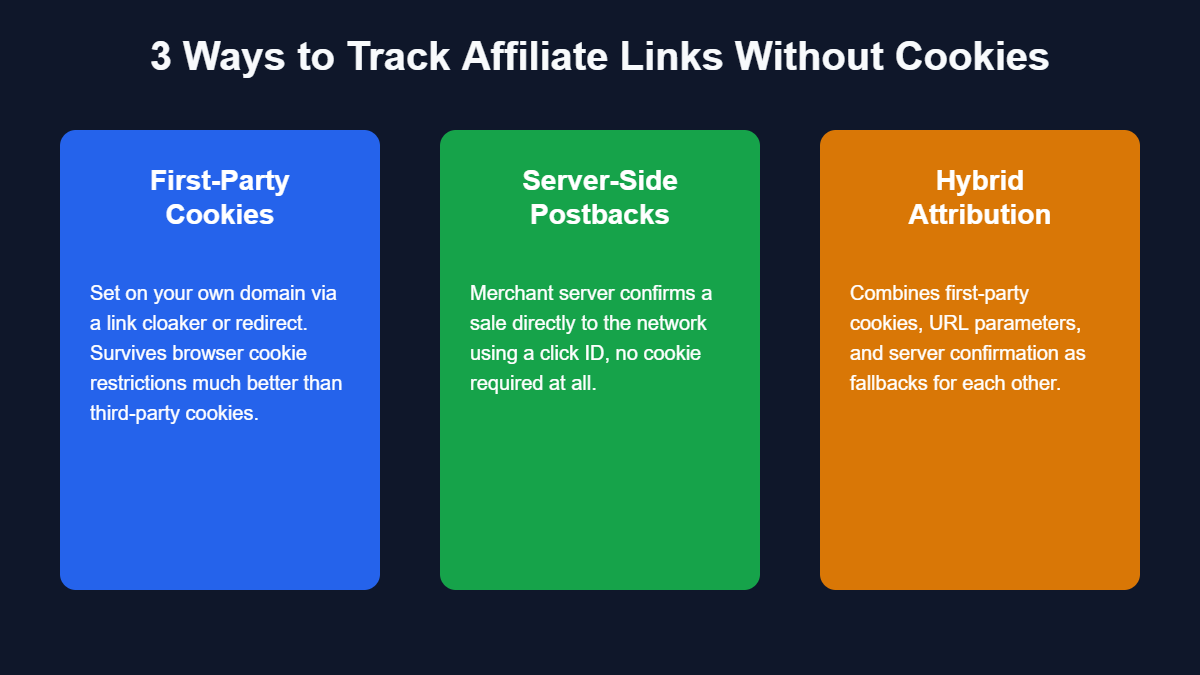
“Cookieless” doesn’t mean there’s no tracking at all. It means the attribution doesn’t depend on a third-party cookie surviving the trip from click to purchase. Most modern cookieless affiliate link tracking tools lean on one or more of these methods:
- First-party cookies set on your own domain (via a link cloaker or redirect you control), which browsers treat far more leniently than third-party ones.
- Server-to-server postbacks, where the merchant’s server tells the network’s server directly that a sale happened, tied to a click ID passed in the URL rather than a cookie.
- URL parameter matching, where a unique ID rides along in the link and gets passed through checkout, so attribution doesn’t depend on any cookie surviving at all.
- Platform-native attribution, used by things like Amazon Associates or TikTok Shop, where the retailer’s own logged-in session does the matching instead of any cookie your link sets.
Whichever method you land on, the goal of any cookieless affiliate link tracking tool is the same: keep your commission data accurate even when the browser or app in front of your visitor won’t cooperate with a third-party cookie.
Comparing the Main Categories of Cookieless Tracking Tools
Rather than naming specific software that will be outdated in a year, it’s more useful to compare the categories these cookieless affiliate link tracking tools fall into, since that’s what actually determines whether a tool will keep working as browser and platform policies keep shifting.
First-Party Link Cloakers
These are plugins or services that route your affiliate links through your own domain before redirecting to the merchant. Because the cookie is set on your domain, not the merchant’s or network’s, it survives browser restrictions much better. This is usually the easiest upgrade for a smaller site, since it doesn’t require touching your existing network relationships. Among cookieless affiliate link tracking tools, this category is the cheapest and fastest to set up, though the tradeoff is that you’re still relying on a cookie of some kind, so it helps to pair this with a longer cookie window where the network allows it.
Server-Side / Postback Trackers
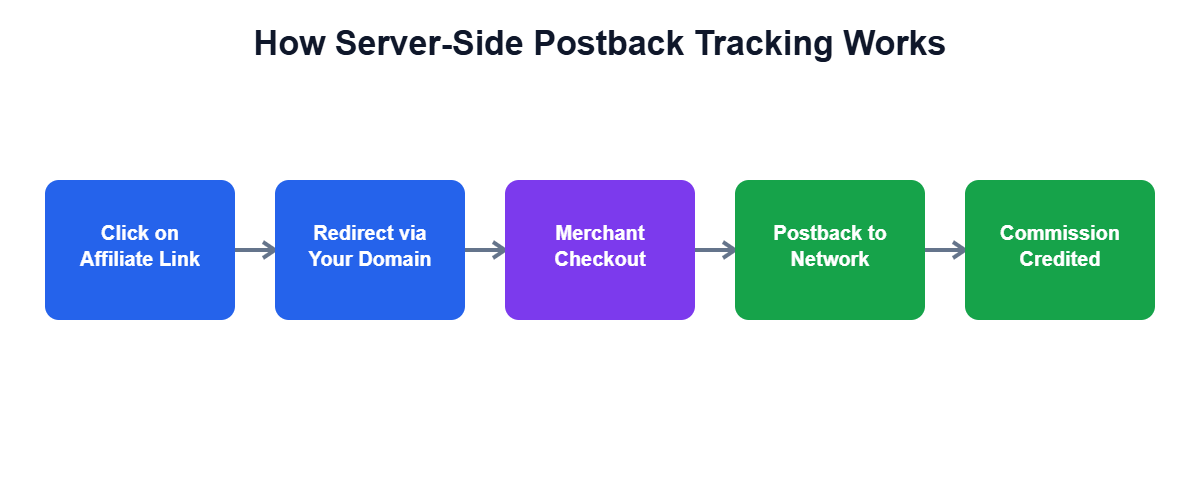
These sit between your click and the merchant’s confirmation, using a unique click ID instead of a cookie to match a sale back to your referral. This is more robust against ad blockers and in-app browsers, but it usually requires the merchant or network to support postback integration, which not every program offers yet. Larger affiliate networks have been the fastest to adopt this category of cookieless affiliate link tracking tools, so it’s worth checking your existing programs before assuming you need new software. If you haven’t compared options recently, our roundup of link tracking tools is a good place to see what’s changed.
Hybrid Attribution Platforms
These combine first-party cookies, URL parameter passing, and server-side confirmation as fallbacks for each other, so if one method fails, another can still catch the conversion. Hybrid cookieless affiliate link tracking tools tend to cost more and have a steeper setup, which makes them better suited to sites already earning enough to justify the investment rather than someone just starting out.
What Cookieless Tracking Tools Typically Cost
Pricing varies a lot by category, so it helps to know roughly what you’re budgeting for before you start comparing specific cookieless affiliate link tracking tools.
First-party link cloakers are usually the cheapest entry point. Many WordPress-based options are a one-time purchase or a low monthly fee, and some are even free for a small number of links, which is why this is the natural starting point for a smaller site testing cookieless affiliate link tracking tools for the first time.
Server-side postback tracking is often bundled into your existing affiliate network account at no extra cost, since the network already has the infrastructure. Where it isn’t included, dedicated postback services typically charge based on tracked click or conversion volume, so cost scales with how much traffic you’re sending.
Hybrid attribution platforms sit at the higher end, usually priced as a monthly subscription based on tracked events or domains. These cookieless affiliate link tracking tools make more financial sense once your affiliate income is already consistent enough to justify the added spend, rather than for someone just testing a new niche.
In short: budget little to nothing for your first cookieless affiliate link tracking tool, and only scale up to paid, hybrid options once the income to justify them is already there.
How to Test Whether You Already Have a Cookieless Tracking Leak
Before you invest time comparing cookieless affiliate link tracking tools, it’s worth confirming you actually have a leak worth fixing. Here’s a simple way to check:
- Open one of your affiliate links in Safari’s private browsing mode and confirm whether the click is still logged in your network’s dashboard.
- Open the same link inside Instagram’s or TikTok’s in-app browser (tap a link from a post rather than opening the app’s regular browser) and repeat the check.
- Compare click counts reported by your own link cloaker against the click counts reported by the affiliate network for the same time period. A large, consistent gap is a sign that cookieless affiliate link tracking tools would recover real, currently uncredited commissions.
- Check whether your reported conversion rate has quietly drifted downward over the last few months without a corresponding change in your content or traffic sources.
If you see meaningful gaps in any of these tests, that’s your signal to prioritize moving to cookieless affiliate link tracking tools rather than treating it as a someday project.
Cookieless Affiliate Link Tracking Tools and Mobile Apps
In-app browsers deserve special attention when you’re evaluating cookieless affiliate link tracking tools, because they behave differently from a normal mobile browser. When someone taps a link inside Instagram, TikTok, or Facebook, the app often opens it in a stripped-down in-app browser that isolates or discards cookies more aggressively than Safari or Chrome do on their own.
This matters a lot if your traffic comes primarily from social platforms, since a huge share of your clicks may be happening inside these in-app environments. Cookieless affiliate link tracking tools that rely purely on first-party cookies can still lose some of these clicks, which is one more reason server-side postback tracking is worth prioritizing if social traffic is a big part of your funnel. Look specifically for cookieless affiliate link tracking tools that mention in-app browser support in their documentation, rather than assuming general cookie compliance covers this case too.
How to Choose Based on Your Site
If you’re running a smaller or newer site, start with a first-party link cloaker. It solves the biggest, most common leak (Safari, Firefox, and in-app browser cookie blocking) for the least setup effort, and most cookieless affiliate link tracking tools in this category integrate with WordPress without custom development.
If you’re already earning consistent commissions and rely heavily on one or two networks, check whether those networks offer server-side postback tracking before buying anything new. You may already have access to a more reliable method sitting unused in your dashboard.
If your traffic comes largely through social platforms with in-app browsers, prioritize cookieless affiliate link tracking tools that explicitly mention in-app browser handling. That’s where a huge share of the “lost” conversions actually happen.
Whichever route you take, make sure your link tracking gives you visibility into click-to-conversion gaps so you can spot problems early instead of just watching commissions quietly shrink. If you haven’t set that up yet, our guide to affiliate link tracking walks through how to structure that reporting from scratch.
Common Mistakes When Switching Tracking Methods
Moving to cookieless affiliate link tracking tools is straightforward, but a few avoidable mistakes trip up most affiliates the first time around.
- Switching everything at once. Migrate your highest-traffic pages first and confirm they’re tracking correctly before touching the rest of the site.
- Not testing with a real click-through. A configuration that looks correct in settings can still fail silently. Click your own link and confirm the redirect and any test conversion actually register.
- Ignoring network-side options already available. Many affiliates buy new cookieless affiliate link tracking tools without first checking whether their existing network already offers server-side postbacks for free.
- Forgetting to update disclosure and privacy pages. If you change how you track visitors, your privacy policy should reflect that, even for first-party, cookie-based cookieless affiliate link tracking tools.
A Simple Migration Checklist
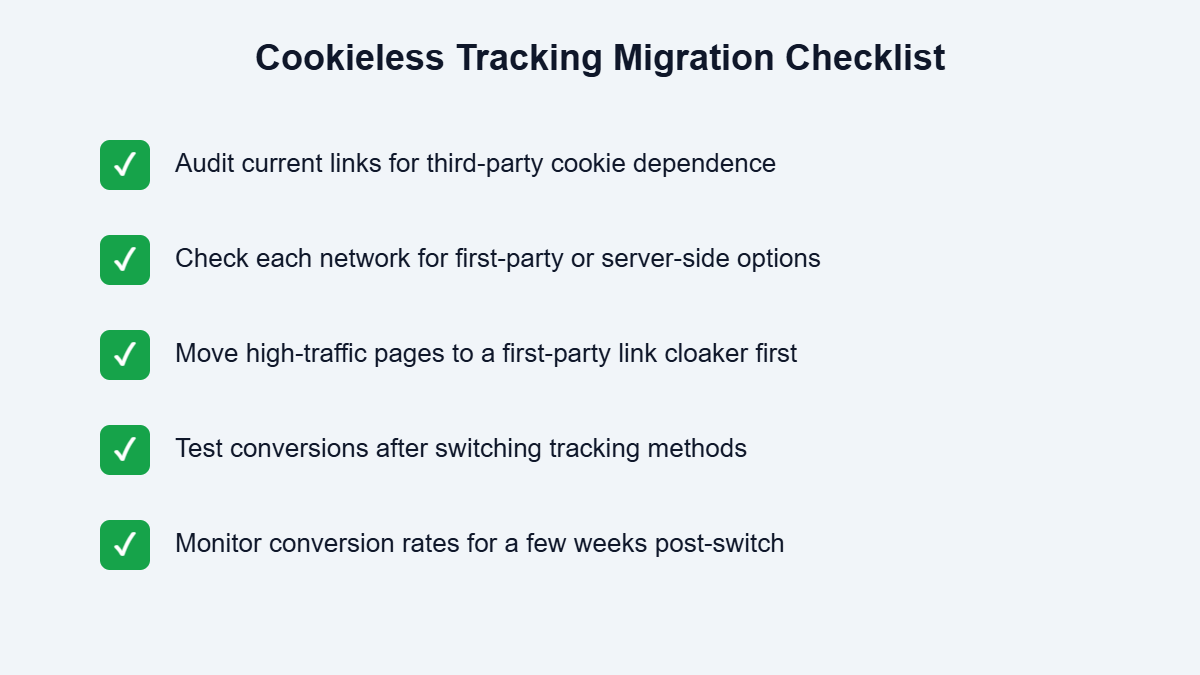
- Audit your current links to see which ones still rely purely on third-party cookies.
- Check each affiliate network for first-party or server-side tracking options you may already have access to.
- Move high-traffic pages to a first-party link cloaker first, since that’s where cookie loss costs you the most.
- Test conversions after switching by making a real (or sandbox) purchase through your own link where possible.
- Keep an eye on reported conversion rates for a few weeks after any change, since tracking issues often take time to show up clearly. Running through our SEO checklist at the same time is a good way to catch other technical issues while you’re already in there.
For more background on how browsers and industry bodies are approaching this shift, the IAB UK’s cookie deprecation resource hub is a useful outside reference to keep bookmarked.
Frequently Asked Questions
Do I need to switch tracking methods right now?
Not urgently, but the direction is clear. Safari, Firefox, and in-app browsers already restrict third-party cookies today, so the sooner you move to cookieless affiliate link tracking tools, the less commission you’ll lose in the meantime.
Will switching tools break my existing affiliate links?
Usually not if you use a redirect-based approach, since the destination URL stays the same and only the tracking layer changes. Still, test a handful of links after any switch to confirm they redirect correctly.
Is server-side tracking only for large sites?
It’s more common among larger networks, but plenty of small and mid-sized affiliates already have access to it through their existing programs without paying for anything extra. It’s worth checking before assuming you need to upgrade to paid cookieless affiliate link tracking tools.
What’s the single biggest cookieless tracking mistake affiliates make?
Assuming a drop in reported conversions means their content stopped converting, when it’s often a tracking gap instead. Before overhauling your content strategy, rule out tracking loss as the cause and consider whether cookieless affiliate link tracking tools would close the gap.
Do cookieless affiliate link tracking tools work with every affiliate network?
Not universally. First-party link cloakers work with almost any network since they operate on your own domain, but server-side postback support depends on whether the specific network or merchant has built that integration.
Is it worth paying for a hybrid attribution tool as a beginner?
Usually not right away. A free or low-cost first-party link cloaker covers most of the benefit for a new site. Hybrid cookieless affiliate link tracking tools earn their cost once your traffic and commission volume are large enough that small tracking gaps translate into real money.
How do I know which cookieless affiliate link tracking tools my competitors are using?
You usually can’t tell directly, and it doesn’t matter much anyway. Focus on the category (first-party, server-side, or hybrid) that matches your traffic sources and budget rather than trying to reverse-engineer a competitor’s specific setup.
Can I use more than one cookieless affiliate link tracking tool at the same time?
Yes, and for many affiliates that’s the realistic end state: a first-party link cloaker for general coverage, paired with server-side postback tracking on the networks that support it. Layering cookieless affiliate link tracking tools this way tends to close more gaps than relying on a single method alone.
None of this requires an overnight overhaul. Start with the leak that’s costing you the most (usually cookie loss on Safari, Firefox, and in-app browsers across your highest-traffic pages), fix that first, and layer in server-side or hybrid tracking as your programs support it. The sites that adapt now to cookieless affiliate link tracking tools will have cleaner data to make decisions with while everyone else is still guessing.