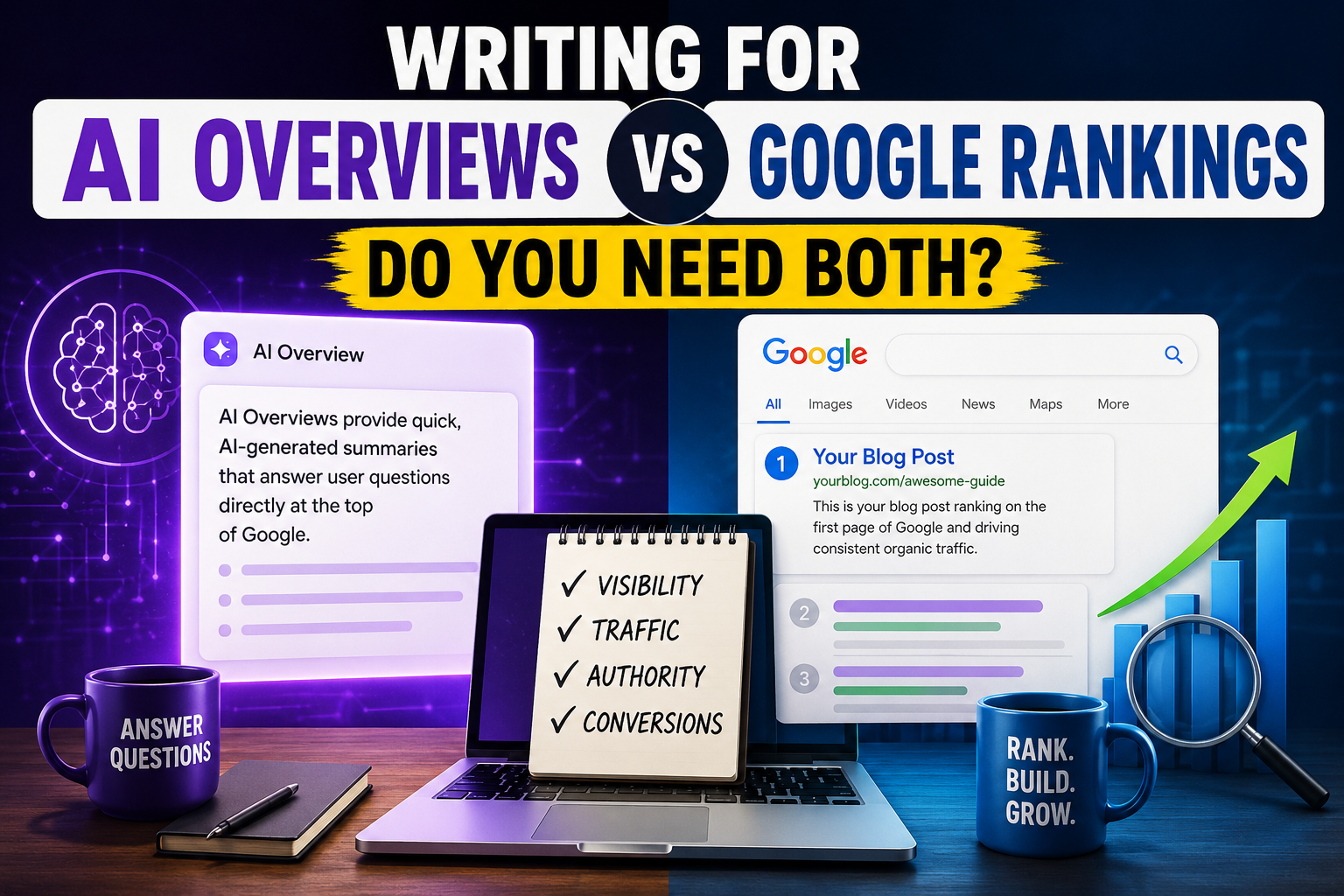
Writing for AI Overviews vs Google Rankings: Do You Need Both?
Disclosure: Some links on this page may be affiliate links. If you buy through them, I may earn a commission at no extra cost to you. I only recommend what I’d use myself. Read the full disclosure.
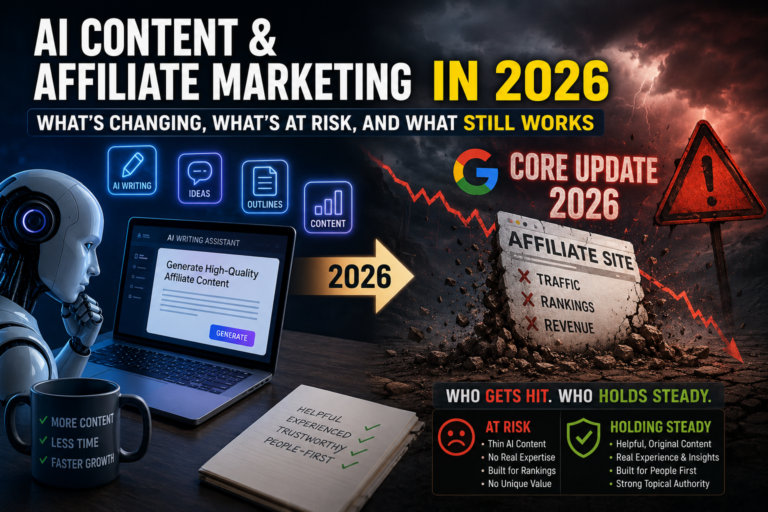
Writing for AI overviews vs Google rankings is the split every affiliate writer needs to understand in 2026. Search results don’t look like they used to — on a lot of queries, the first thing you see isn’t a blue link, it’s an AI-generated summary sitting above every organic result, including the #1 spot you worked so hard to earn. That’s changed the math for affiliate publishers, and it means writing for search rankings and writing for AI Overviews aren’t automatically the same task anymore.
AI Overviews now show up on roughly half of Google searches, and when one appears, the click-through rate to the organic results below it tends to drop noticeably. That’s the uncomfortable part. The useful part is that you can still influence whether your content gets pulled into that summary — it just takes some different habits than pure ranking optimization.
What “Writing for Rankings” Actually Means
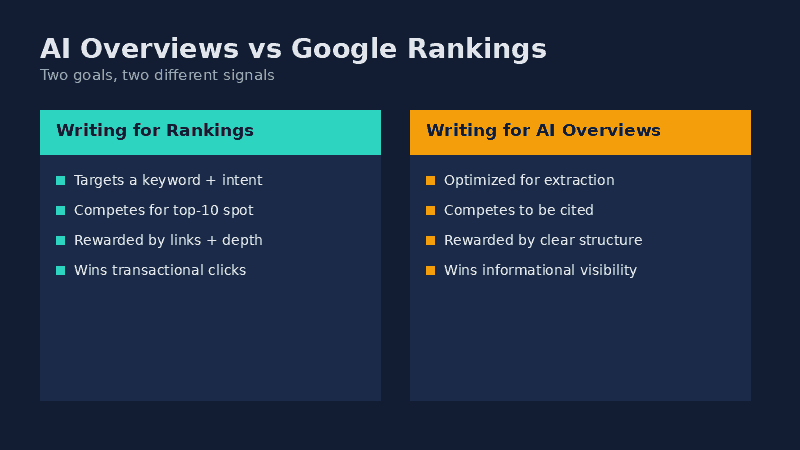
Writing for rankings is the affiliate SEO you already know: targeting a keyword, matching search intent, building topical depth, earning links, and giving Google enough signals to trust your page for a specific query. It’s built around competing for a position — you’re trying to outrank the other ten (or three) results on the page.
That approach still works. Rankings still drive traffic, especially for transactional and commercial-investigation queries where people want to compare options before buying. But rankings alone don’t guarantee visibility anymore, because the AI summary sitting above the results is answering a chunk of searchers’ questions before they ever scroll down.
What “Writing for AI Overviews” Actually Means
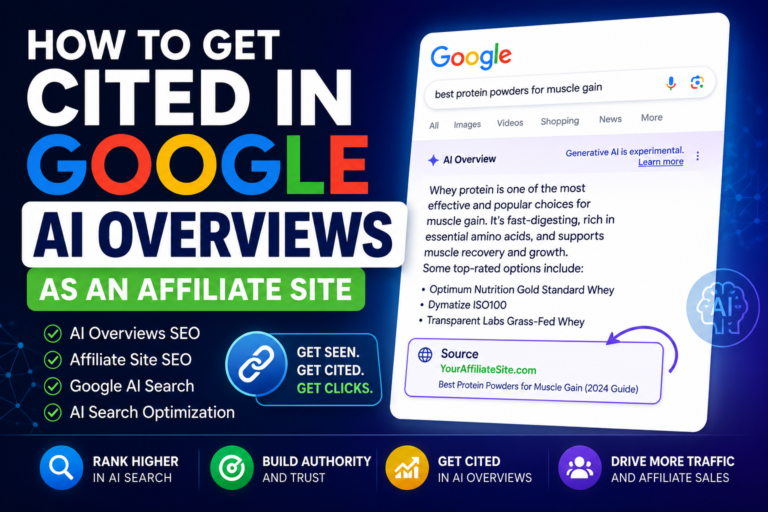
Writing for AI Overviews means writing in a way that makes it easy for an AI system to lift a clear, accurate, well-supported answer out of your page and use it — ideally with your site cited as the source. It rewards different things than a pure ranking play: Google’s own documentation on AI features in Search confirms there’s no separate playbook for this — the same helpful, people-first content standards that earn rankings are what get pulled into AI Overviews.
- Direct, self-contained answers near the top of a section, not buried under three paragraphs of preamble.
- Clear structure — headings that match the actual question being asked, short paragraphs, and lists where they help.
- Specific, well-organized information the AI can extract cleanly, rather than vague or opinion-heavy phrasing.
- Content that’s genuinely useful on its own, since these systems tend to favor pages that fully resolve a question rather than ones that tease an answer to get a click.
Notice what’s missing from that list: keyword density, backlink count, and domain authority tricks. Those still matter for rankings, but they’re not the main lever for getting summarized and cited.
Why the Two Goals Aren’t the Same Anymore
A page can rank #1 and still get skipped by an AI Overview if the answer isn’t easy to extract. And a page can show up inside an AI Overview citation without ever cracking the top five organic results, if it answers the specific question clearly enough.
That’s the shift you need to internalize: ranking position and AI Overview inclusion are now two separate outcomes, generated by two overlapping but distinct sets of signals. You can win one without the other. Ideally, you want both, because they serve different parts of your traffic. Data from Ahrefs has tracked a sizable drop in click-through rate for top-ranking pages once an AI Overview appears on a query, which is exactly why treating the two as interchangeable goals stops working. Tightening up your on-page structure — the same fundamentals covered in a solid SEO checklist — still matters for both.
Rankings still matter most for people who scroll past the AI summary or search on queries where no overview appears — often more transactional, “best X for Y” style searches. AI Overview visibility matters for the broad informational questions where people used to click through to a blog post just to get a straightforward answer.
Do You Actually Need Both?
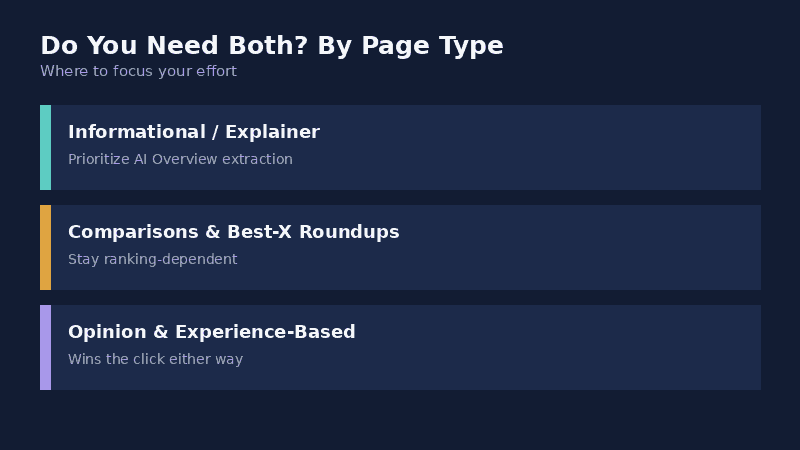
For most affiliate sites, yes — but not with equal effort on every page. It helps to think about it by page type:
Informational and “what is / how does” content
These pages are prime AI Overview territory. If you’re writing an explainer, structure it so the core answer appears early and cleanly, in a format that’s easy to lift: a short direct paragraph, a clear list, or a simple table. You’re optimizing for both rankings and extraction here, but extraction should get equal priority. This is also the content type that benefits most from being organized into topic clusters, since a well-linked hub gives both readers and AI systems more context to pull from.
Product comparisons and “best X” roundups
These tend to stay more ranking-dependent, especially once affiliate links and personal recommendations are involved. AI Overviews are more cautious about summarizing commercial recommendation content, so classic on-page SEO — comparison tables, clear criteria, updated pricing — still carries more weight here.
Deep, opinionated, or experience-based content
Posts built around your own testing, a strong point of view, or original data are harder for an AI system to compress into a neutral summary, and that’s fine. This is the content most likely to earn a click even when an overview is present, because readers want the fuller story, not just the fact.
Practical Changes to Make in Your Writing Process
You don’t need to rebuild your entire content process. A few adjustments go a long way:
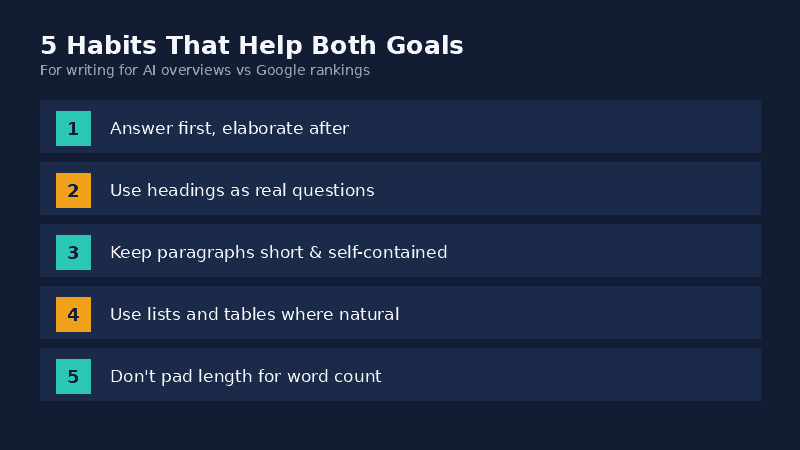
- Answer first, elaborate after. Put a clear, direct answer to the implied question within the first sentence or two of a section, then expand with context, caveats, and detail below it.
- Use headings as real questions. “How Long Does It Take to Rank an Affiliate Site?” pulls double duty — it matches how people search and gives an AI system a clean chunk to extract.
- Keep paragraphs short and self-contained. Dense, meandering paragraphs are harder to summarize accurately and harder for readers to skim, so tightening them up helps both goals at once.
- Use lists and tables where they fit naturally. Don’t force it, but structured data is easier to extract and easier to scan.
- Don’t bury the lede for the sake of “content length.” Padding an article to hit a word count can actually hurt your odds of being summarized cleanly, because the useful part gets diluted.
This is also a good moment to revisit your overall affiliate content strategy and check whether your existing posts are structured for extraction, not just ranking. A lot of older content was written purely to satisfy a keyword, with the actual answer scattered across several paragraphs — that’s exactly the kind of page an AI Overview is likely to skip over in favor of a competitor.
What This Means for Your Traffic Numbers
If you’re seeing flat or declining click-through rates on pages that still rank well, AI Overviews are a reasonable place to look before assuming something is technically wrong. It doesn’t necessarily mean your SEO failed — it can simply mean the query now gets partially answered above your listing, and fewer people need to click through for the basic version of the answer. The picture isn’t static, either — recent tracking from Search Engine Land shows AI Overview click-through rates shifting over time as both Google and publishers adjust, so a drop this quarter isn’t necessarily permanent.
The pages most likely to hold up are the ones offering something an AI summary can’t fully replace: a comparison table, a personal recommendation, updated pricing, or a next step the reader actually needs to take (like clicking through to sign up for something). Pure definitional content is the most exposed, which is one more reason to lean into original insight and specific, useful detail rather than generic explanations.
FAQ
Does optimizing for AI Overviews hurt my regular SEO?
No. The habits that help with AI Overview extraction — clear structure, direct answers, real headings — are also good SEO practices on their own. You’re not trading one for the other.
Can affiliate content even get cited in AI Overviews?
Yes, though commercial and recommendation-heavy content is treated more cautiously than neutral informational content. Your best odds are on genuinely informational sections of your site, with commercial pages relying more on strong on-page SEO and a compelling reason to click through.
Should I stop writing long-form content?
Not necessarily — long-form is still valuable for depth and trust. The key is structuring long content so each section can stand on its own with a clear answer, rather than making readers (or an AI system) piece the answer together across the whole page.
How do I know if AI Overviews are affecting a specific page?
Search the target keyword yourself and see whether an AI Overview appears. If it does, compare your click-through rate on that query before and after the overview showed up. A drop in clicks with stable rankings is a common sign.
You don’t have to choose between ranking and being summarized — most affiliate sites need a mix of both, applied differently depending on the page. Tighten up your structure, lead with real answers, and keep the content that genuinely needs a click distinct from the content that’s just there to inform. That balance is what keeps traffic coming in from both directions.
Niche → offer → SEO cluster → Pinterest pins → first clicks. No fluff.