3 Reasons Cookieless Affiliate Tracking Pays More
Disclosure: Some links on this page may be affiliate links. If you buy through them, I may earn a commission at no extra cost to you. I only recommend what I’d use myself. Read the full disclosure.
If you run an affiliate program, cookieless affiliate tracking probably sounds like one more buzzword you can safely ignore. You’ve heard “the cookie is dying” every year since 2018. You watched Google delay the funeral four times. Then, in 2024, Google canceled it outright. So I get it. When another vendor waves a “cookieless” banner, your hand goes straight to the close button. Good. Hold onto that skepticism. Because the real argument here has nothing to do with the prediction you stopped believing years ago — and everything to do with the commissions leaking out of your program right now.
Table of Contents
Why the Third-Party Cookie Story Was Hype — and Why It Still Costs You
Let’s clear the air first. The “Chrome kills cookies” narrative was hype. Google spent six years telling the industry that Chrome would deprecate third-party cookies. In 2024, it quietly abandoned the forced phase-out and moved to a user-choice model. By late 2025, it had shut down most of the Privacy Sandbox APIs it built as the replacement. If you rolled your eyes at all of it, you were right to. The doomsday clock was fake.
But here’s where most skeptics make one wrong move. They heard “the prediction was wrong,” so they assumed “nothing changed.” Those are two completely different things. The prediction was about Chrome’s future. Your problem is happening in the present, in every other browser your traffic already uses.

Half Your Affiliate Clicks Are Already Cookieless
Forget Chrome for a second. Look at Safari. Safari has blocked third-party cookies by default since 2020. Firefox walls them off by default too. Add Brave, DuckDuckGo, and every ad blocker, and roughly half the web is already cookieless. This isn’t coming. It arrived years ago while everyone stared at Google.
Now here’s the part that should sting. Safari goes further than blocking third-party cookies. It also limits the cookies your own site sets with JavaScript. After seven days, those are gone too. Apple calls this Intelligent Tracking Prevention, or ITP, and the seven-day cap on script-set cookies is spelled out in WebKit’s own documentation.
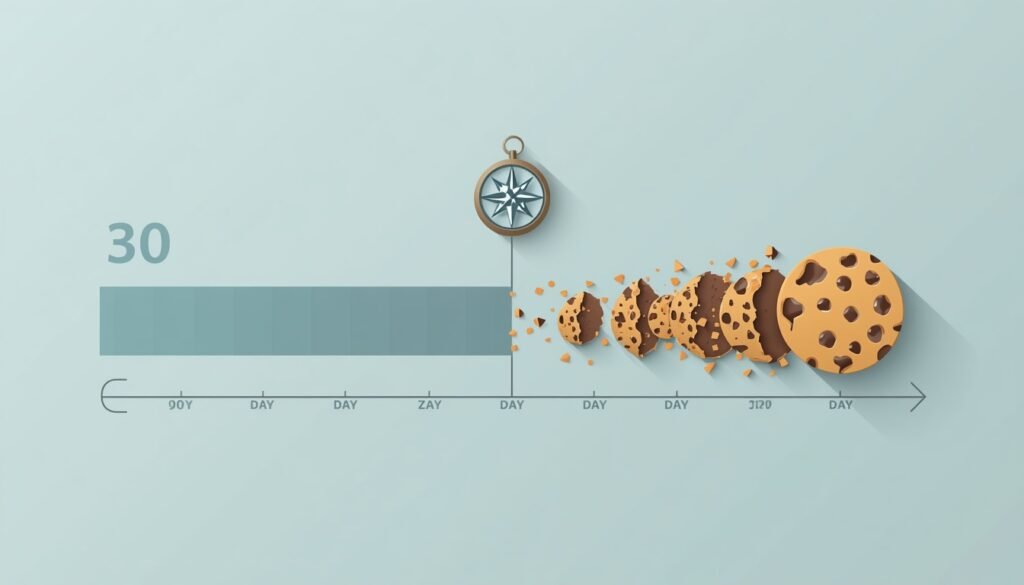
Read that again. Seven days. Think about your attribution window. Most affiliate programs run 30 days. Some run 60 or 90. So a shopper clicks your partner’s link, browses, and comes back on day 10 to buy. On Safari, that cookie is already gone. The sale gets logged as “organic.” Your affiliate gets nothing.
That’s not a hypothetical. That’s a receipt you’re already paying, on roughly a quarter to a third of your desktop traffic, every single day.
Why Mobile and In-App Browsers Break Affiliate Tracking
Most affiliate clicks now come from phones. And phones are where cookie tracking falls apart completely. In-app browsers, the ones inside Instagram, TikTok, and Facebook, block third-party cookies by default — and they’re the same platforms already cutting affiliate commissions at the source. A huge share of your clicks start there. On iOS, App Tracking Transparency has been live for five years. It still cuts affiliate attribution on iPhones by 60 to 80 percent.
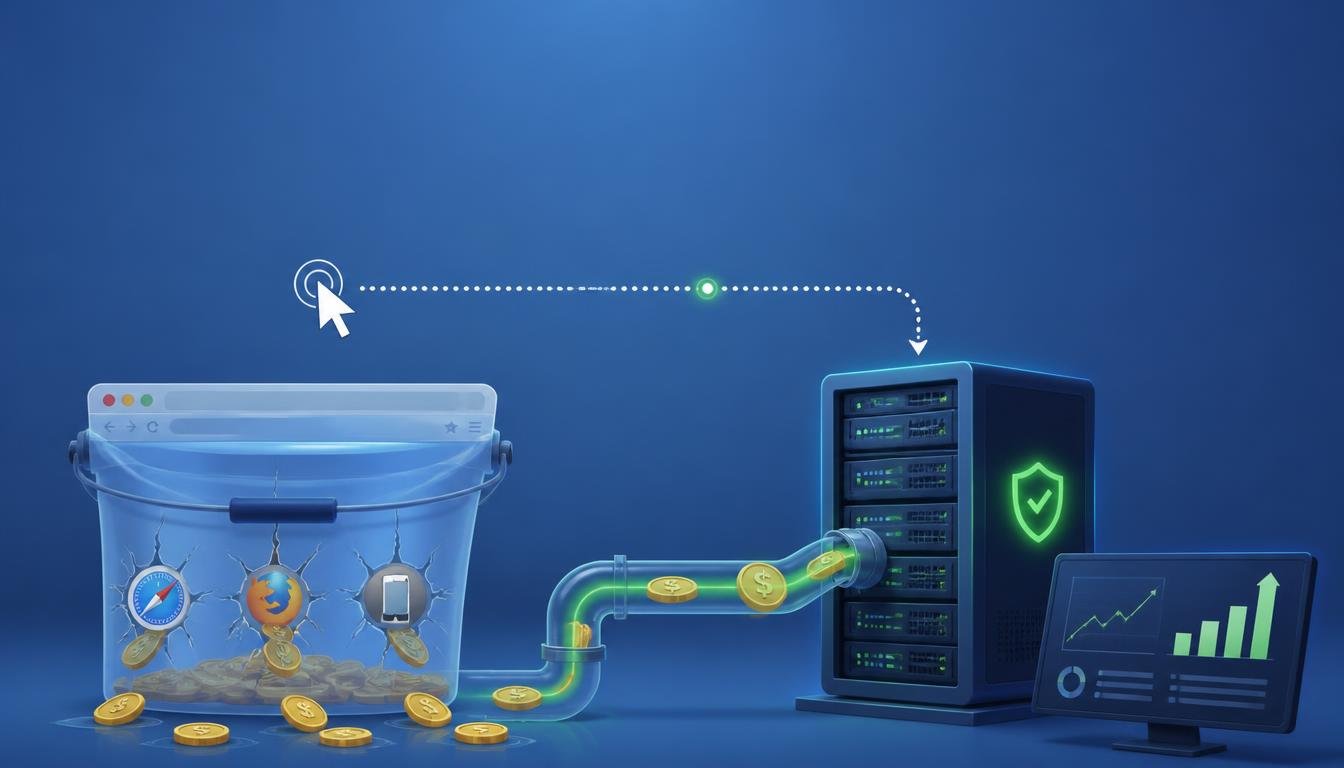
So stack it up. Safari’s 7-day cap. Firefox blocking by default. In-app browsers blocking on open. iOS gutting attribution. You’re not waiting for a cookieless future. You’re standing in a cookieless present, watching commissions leak out of a bucket full of holes.
And here’s the quiet cost nobody puts on a dashboard: your partners feel it before you do. Your best affiliates track their own numbers. When their analytics show 100 sales and your platform pays for 68, they don’t assume Safari ate the difference. They assume you’re shaving them. Trust erodes. The good ones drift to programs that pay accurately. You lose your best partners without ever seeing the invoice. Accurate tracking is how you keep them — and spreading your income across more than one platform is how you stay safe when one of them changes the rules again.
Is Cookieless Affiliate Tracking Just Device Fingerprinting?
This is the objection I hear from every sharp marketer, so let’s kill it directly. Because if “cookieless” meant device fingerprinting, you’d be right to run. It doesn’t.
Fingerprinting is basically dead. Browsers now hide or scramble the very details it needed, like your fonts and device type. Regulators can fine companies that use it. So it’s no longer something you can build on. At best, it helps flag fraud.
Real cookieless affiliate tracking uses something completely different, and far cleaner. It’s called server-to-server tracking, or S2S postback. So how does cookieless affiliate tracking actually work?
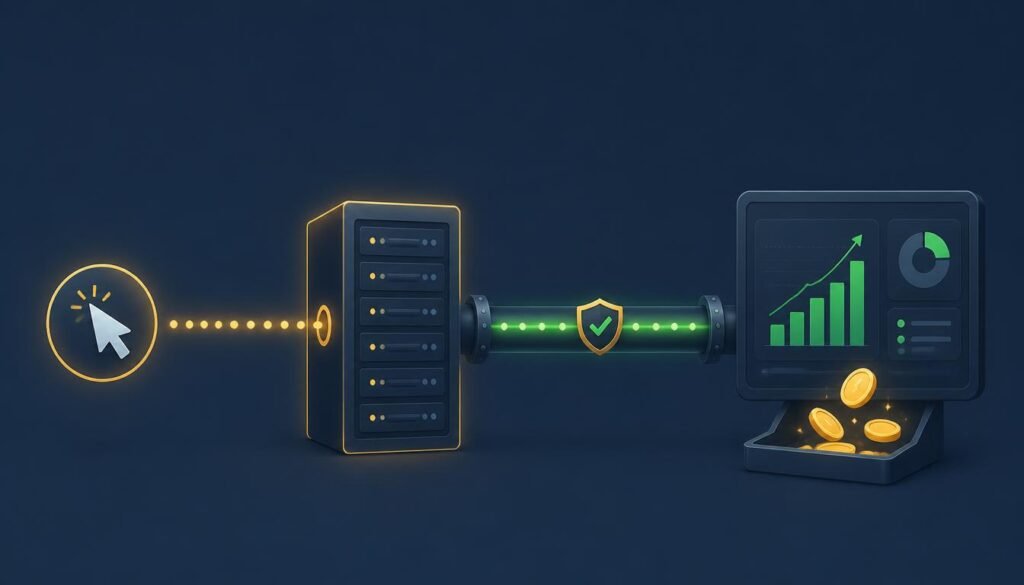
Cookieless affiliate tracking works through server-to-server (S2S) postback:
- The affiliate link carries a unique click ID.
- That ID passes to the advertiser’s server.
- When a sale happens, the server fires a postback to the affiliate platform, matching the click to the conversion.
No third-party cookie is needed.
Here’s the same idea in plain terms. Your partner’s link carries a simple click ID. That ID travels to the advertiser’s own server. When the conversion happens, the advertiser’s server sends one direct message, a “postback,” to your affiliate platform. That message says: this click just became this sale, for this amount.
Notice what’s missing. No third-party cookie. No cross-site snooping. No fingerprint. The browser never has to remember anything for 30 days, so it can’t forget.
If you’d rather see a postback fire end to end than read about it, this short explainer walks through the exact click-ID-to-conversion flow:
Why Server-to-Server Tracking Beats Browser Cookies
The reason S2S works is almost boringly simple. It moves the record-keeping out of the browser and onto machines that don’t lie to you.
A browser is a hostile environment now. It blocks, it caps, it forgets, it gets ad-blocked. You are trusting your revenue to software built to erase your tracking. A server-to-server call doesn’t care about any of that. It has:
- No cookie dependency — nothing to block, nothing to expire.
- No ad blocker interference — ad blockers work in the browser; the postback never touches it.
- No cross-device gap — a click on mobile and a purchase on desktop still connect through the ID.
This is why the sharpest programs treat the browser as a nice-to-have and the server as the source of truth. Client-side pixels become a backup signal, not the foundation.
The first affiliate program I moved to S2S saw its reported conversions climb about 22% in the first week — and almost all of that lift was mobile sales the old pixel had been quietly dropping. Nothing about the traffic changed. We just finally counted it.
And this isn’t fringe. Around 70% of affiliate platforms have already adopted or are actively migrating to cookieless tracking. The people who move the most money already switched. The debate is over inside the rooms that matter.
How to Set Up S2S Postback Tracking Without a Rebuild
The last wall of resistance is always cost. You picture a migration, broken attribution for weeks, and a furious dev team. Fair fear. Wrong scale.
A basic S2S postback is not a rebuild. In its simplest form it’s one endpoint and one click ID that fires on conversion. Many platforms document setups that take a developer under a day. Want the full server-side stack, with a dedicated tagging server and everything routed through your own domain? That’s a bigger job, usually a few weeks for a clean migration. But you don’t start there. You start with the leak that’s costing the most — first deposits, high-value purchases, mobile conversions — and route those through S2S first. Pixels keep running underneath as a fallback while you go.
Now weigh it honestly. A few hours to a few weeks of setup, one time. Against a permanent 20 to 30 percent attribution leak, forever, that quietly drives away your best partners.
Marketers who made this switch report attribution that’s not just better than today. It’s better than the old cookie world ever was, because it finally captures the mobile and cross-device sales pixels always missed. That setup work doesn’t cost you money. It returns money you’re currently giving away.
How Cookieless Tracking Keeps You GDPR Compliant
Here’s the twist most skeptics never see coming. Cookieless tracking doesn’t just survive privacy law. It gets stronger because of it.
Third-party cookies are the exact thing regulators — GDPR, ePrivacy, enforcement agencies — are hunting. Building your program on them means building on the one foundation guaranteed to keep cracking. And the rulebook only expands: the FTC’s 2026 disclosure rules now reach livestreams and short-form video, so clean, defensible measurement matters more every quarter.
The rules are pushing everyone toward server-side tracking built on first-party data and real consent — the same ground any serious guide to affiliate networks, tracking, and compliance already walks you through. You send each user’s consent choice to the server. You keep clean records. And you can prove every payout was fair. I’ve sat in audit reviews where one clean server-side log closed the question in five minutes — good luck doing that with a pile of expired browser cookies.
So while competitors play whack-a-mole with every browser update and every new enforcement action, your measurement just holds. Steady numbers. Consistent payouts. Partners who trust you. That reliability isn’t a compliance chore. It’s a competitive advantage most of your rivals are too stubborn to claim.
Cookieless Affiliate Tracking: Your Next Move
Your skepticism was right about one thing and wrong about another. Right: nobody is killing the cookie in Chrome on some countdown clock, and you were smart to tune that noise out. Wrong: assuming that meant your numbers were safe. They aren’t. Safari, Firefox, in-app browsers, and iOS are deleting your affiliate commissions today, and your sharpest partners can already see the gap in their own dashboards.
Cookieless affiliate tracking isn’t a bet on the future. It’s how you stop paying for a leak that’s wide open right now. So do one thing this week: take your single highest-value conversion, wire it through a server-to-server postback, and leave your pixel running as a backup. Then watch your reported sales climb toward the numbers your partners already trust, and let the recovered commissions fund the next fix.
The programs that pay on time already did this quietly. The only question left is how long you’ll keep funding the gap before you close it.
Niche → offer → SEO cluster → Pinterest pins → first clicks. No fluff.