
FTC Disclosure Rules Livestream Short Form Video 2026: Critical Changes for Creators
Disclosure: Some links on this page may be affiliate links. If you buy through them, I may earn a commission at no extra cost to you. I only recommend what I’d use myself. Read the full disclosure.
FTC disclosure rules livestream short form video 2026 spell out exactly what you need to show viewers before you post another affiliate link in a TikTok, a Reel, or a livestream. The agency’s new guidance closes a gap that video-first creators had been leaning on for years: the idea that disclosure rules were really written for text, and video was a gray area. It isn’t anymore.
Table of Contents
- What Changed in the FTC’s 2026 Disclosure Rules
- Why Livestreams and Short-Form Video Are in Scope Now
- The New Thumbnail Disclosure Requirement
- What “Clear and Conspicuous” Means for Video
- What This Means If You’re a Micro-Influencer
- A Practical Checklist for Compliant Video Disclosures
- FAQ: FTC Disclosure Rules for Video and Livestreams
What Changed in the FTC’s 2026 Disclosure Rules
For most of the past decade, the FTC’s endorsement guidance was written with blog posts and static images in mind. It talked about disclosures being “clear and conspicuous,” but the examples leaned heavily on text on a page. Creators working in livestreams, Stories, and short-form video often applied those same principles loosely, and enforcement followed suit.
The 2026 update changes that. It explicitly extends disclosure requirements to livestreams and short-form video formats, and it adds a requirement that wasn’t spelled out before: a disclosure visible in the video thumbnail itself, not just somewhere in the caption or three minutes into the clip. The agency also signaled it’s paying closer attention to smaller creators, not just the accounts with millions of followers.
| Before 2026 | Now (2026 update) |
|---|---|
| Disclosure anywhere in the caption or description | Visible label on the thumbnail or opening frame |
| One mention at the start of a livestream | Disclosure repeated periodically throughout the stream |
| Guidance mainly framed around blog posts and images | Livestreams and short-form video named explicitly |
| Smaller accounts assumed to be low priority | Audience size doesn’t change the obligation |
Why Livestreams and Short-Form Video Are in Scope Now
The shift makes sense when you think about how people actually discover affiliate content today. A huge share of product recommendations now happen inside a 30-second video or a live shopping session, not a written review. Regulators tend to follow where the money and the complaints go, and short-form video has become one of the biggest channels for affiliate promotion.
Livestreams present their own problem: viewers can join at any point. If your only disclosure is a sentence you said in the first ten seconds, someone who joins the stream at minute fifteen never sees it. The updated rules account for that by expecting disclosures to repeat or persist throughout a livestream, not just appear once at the start.
There’s a practical reason this took a few years to formalize: live shopping and short-form video didn’t carry meaningful affiliate volume until relatively recently. Now that a real share of purchase decisions happen inside a livestream or a 30-second clip, the old assumption that disclosure rules mainly governed written reviews stopped matching how people actually shop. The FTC’s update is really just catching the guidance up to where the money and the audience already moved.
It also reflects how fragmented attention has become. A viewer scrolling through a feed of Reels or Shorts spends a few seconds per clip, decides whether to keep watching almost instantly, and rarely goes back to check a description after the fact. Regulators writing disclosure rules for that environment have to assume the disclosure will only be seen if it’s visible in the same instant as the content itself — which is exactly why the thumbnail and opening-frame requirement exists.
The New Thumbnail Disclosure Requirement
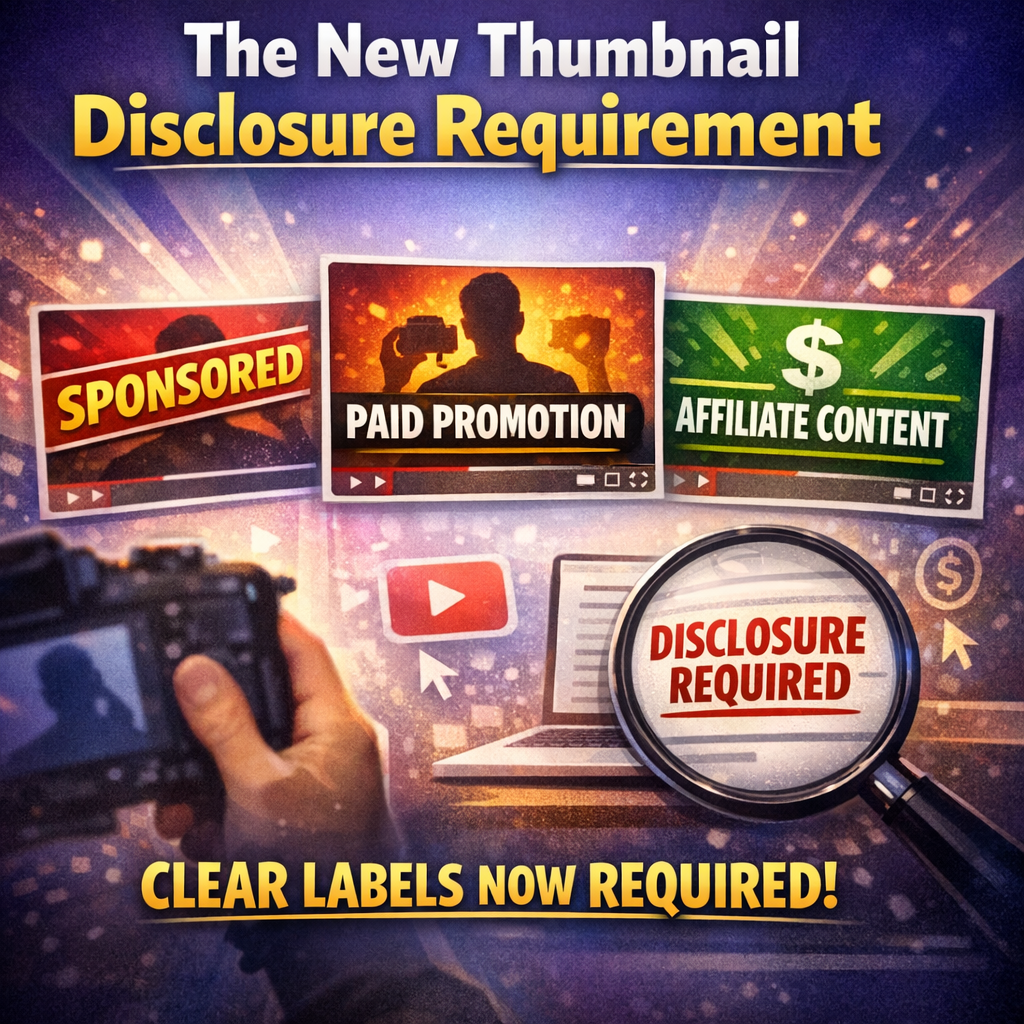
This is the part catching the most creators off guard. Under the 2026 guidance, a disclosure buried in a video description or spoken quickly in the audio isn’t enough on its own for content where a thumbnail is the primary thing a viewer sees before deciding to click or scroll past. The expectation now is that the thumbnail itself, or the on-screen text in the first moment of the video, carries some visible indication that the content includes a paid or affiliate relationship.
In practice, that usually means a short label like “Ad” or “#affiliate” placed directly on the image or in the opening frame, not tucked into a caption below the fold. If someone would have to tap “see more” or read past a wall of hashtags to find your disclosure, it doesn’t meet the standard.
What “Clear and Conspicuous” Means for Video
The FTC has long used a few consistent factors, most recently detailed in its Endorsement Guides FAQ, to judge whether a disclosure counts as clear and conspicuous, and those factors still apply here, just translated to video:
- Placement — the disclosure needs to be somewhere a viewer will actually see or hear it, not buried at the end of a long caption.
- Prominence — text disclosures should be large enough to read and on screen long enough to register, not a flash frame.
- Timing — for livestreams, one mention at the start isn’t enough; it needs to reappear periodically for viewers who join late.
- Plain language — vague terms like “partner” or “collab” don’t clearly communicate a paid or affiliate relationship the way “ad” or “affiliate link” does.
None of this is really new in spirit. It’s the same standard that’s applied to blog posts for years — we cover the underlying four-factor clear-and-conspicuous test in more depth elsewhere. What’s new is that the FTC is now naming video and livestream formats explicitly, so “I didn’t think it applied to Reels” isn’t a credible defense anymore.
What This Means If You’re a Micro-Influencer
A common assumption among smaller creators has been that enforcement only targets accounts with huge followings. The 2026 guidance, echoed in the FTC’s own Disclosures 101 for Social Media Influencers resource, pushes back on that. The FTC’s updated language makes clear that audience size doesn’t change the obligation — if you’re recommending a product in exchange for commission, a free product, or any other compensation, the disclosure requirement applies whether you have 500 followers or five million.
This matters because a lot of affiliate income for smaller sites and creators now comes through exactly the channels the update targets: short-form video with an affiliate link in the bio or pinned comment, and live shopping sessions. If that’s part of your income mix, this isn’t a rule you can assume doesn’t reach you.
It’s also worth separating two different risks here. One is regulatory: the FTC can, in theory, investigate and take action against any creator regardless of size. The other is platform-level: TikTok, Instagram, and YouTube have their own branded-content disclosure tools, and using them alongside a visible on-screen disclosure gives you two layers of protection instead of one. Relying only on a platform’s built-in “paid partnership” label without your own visible disclosure can still leave you short of the FTC’s standard, since that standard focuses on what the viewer actually sees, not just what metadata is attached to the post.
A Practical Checklist for Compliant Video Disclosures
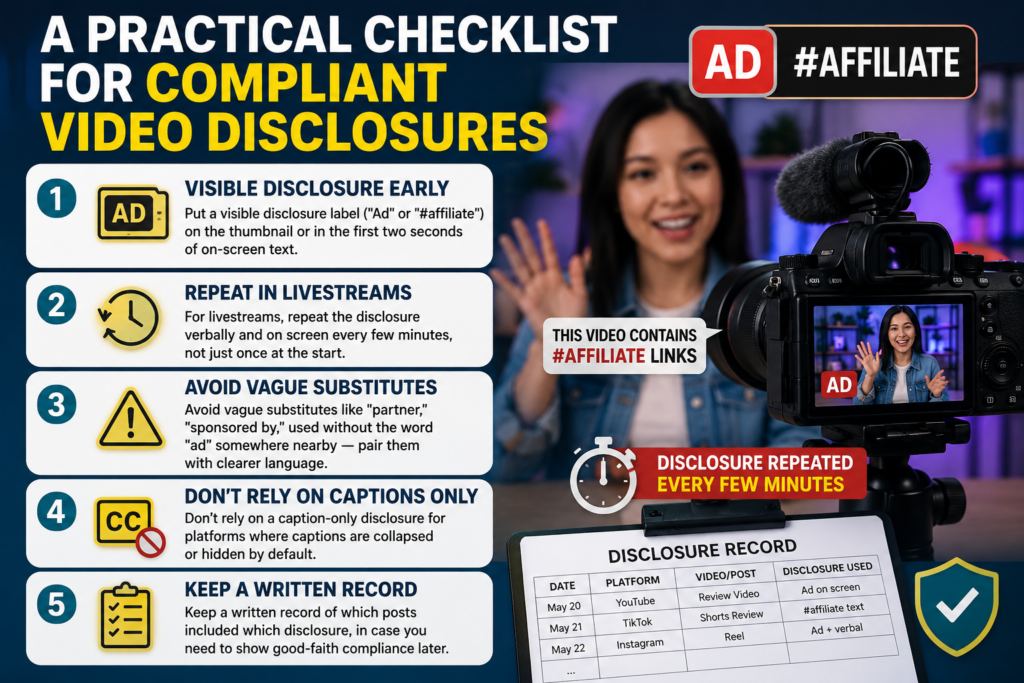
- Put a visible disclosure label (“Ad” or “#affiliate”) directly on the thumbnail or in the first two seconds of on-screen text.
- For livestreams, repeat the disclosure verbally and on screen every few minutes, not just once at the start.
- Avoid vague substitutes like “partner,” “sponsored by,” used without the word “ad” somewhere nearby — pair them with clearer language.
- Don’t rely on a caption-only disclosure for platforms where captions are collapsed or hidden by default.
- Keep a written record of which posts included which disclosure, in case you need to show good-faith compliance later.
If you want the fuller picture of what counts as adequate disclosure outside of video specifically, our guide to writing an affiliate disclaimer walks through the wording and placement basics that still apply across every format. You can also browse more of our Networks & Compliance guides for related FTC and network-policy topics.
FAQ: FTC Disclosure Rules for Video and Livestreams
Does this apply to Instagram Stories too, or just Reels and TikTok?
The update is written broadly enough to cover any short-form or ephemeral video format, including Stories. The underlying test is the same everywhere: would a typical viewer clearly understand there’s a paid or affiliate relationship without having to dig for it.
Do I need the word “ad” specifically, or can I use something like “gifted”?
“Gifted” is fine when a product was genuinely given to you for free with no expectation of promotion, but if you’re also earning affiliate commission on the same content, that needs its own clear label. When in doubt, plain terms like “ad” or “affiliate link” are safer than softer alternatives.
What if I only have a small following — am I really at risk?
The 2026 guidance specifically calls out that follower count doesn’t exempt you. Enforcement priority may still lean toward larger or repeat offenders, but the rule itself applies regardless of audience size.
Is a disclosure in my video description enough?
Not on its own, if the description is collapsed or hidden until a viewer taps to expand it. It should be paired with a visible on-screen or thumbnail disclosure so it’s seen without extra action from the viewer.
That’s the short version of FTC disclosure rules livestream short form video 2026 — moving your disclosure earlier and making it a little more visible than you might have before. Treat it as a five-minute addition to your existing workflow, not a reason to rework your whole video strategy.
Niche → offer → SEO cluster → Pinterest pins → first clicks. No fluff.