
Affiliate Marketing for Beginners: The Complete Step-by-Step Guide
Disclosure: Some links on this page may be affiliate links. If you buy through them, I may earn a commission at no extra cost to you. I only recommend what I’d use myself. Read the full disclosure.
If you’ve ever wondered how people earn money online while they sleep, affiliate marketing is likely the answer. It’s one of the most accessible, low-risk ways to build a passive income stream — and you don’t need to create a product, manage inventory, or handle customer service to do it.
In this complete guide to affiliate marketing for beginners, you’ll learn exactly what affiliate marketing is, how it works, how to choose the right niche and programs, and the proven strategies that can take you from zero to your first commission — and beyond.
Table of Contents
- What Is Affiliate Marketing?
- How Affiliate Marketing Works
- Step 1: Choose Your Niche
- Step 2: Join the Right Affiliate Programs
- Step 3: Build Your Platform
- Step 4: Create High-Converting Content
- Step 5: Drive Targeted Traffic
- Pro Tips to Earn Faster
- Common Mistakes to Avoid
- FAQ
What Is Affiliate Marketing?
Affiliate marketing is a performance-based business model where you earn a commission by promoting someone else’s products or services. When a person clicks your unique affiliate link and makes a purchase, you receive a percentage of the sale — with zero involvement in fulfilment, shipping, or customer support.
Think of it as being a digital salesperson, except you set your own hours, work from anywhere, and your “sales floor” is the internet. It’s a win for everyone: the merchant gets more customers, the customer discovers useful products, and you earn a commission.
💡 Key Definition: Affiliate marketing is the process of earning a commission by promoting other people’s (or companies’) products. You find a product you like, promote it to others, and earn a piece of the profit for each sale that you make.
How Affiliate Marketing Works
The affiliate marketing process involves four core players:
- The Merchant — The brand or company that creates the product (e.g., Amazon, software companies, online course creators).
- The Affiliate Network — The platform that connects merchants and affiliates (e.g., ShareASale, CJ Affiliate, ClickBank).
- The Affiliate (You) — The publisher or marketer who promotes the product to their audience.
- The Customer — The person who clicks your link and makes a purchase.
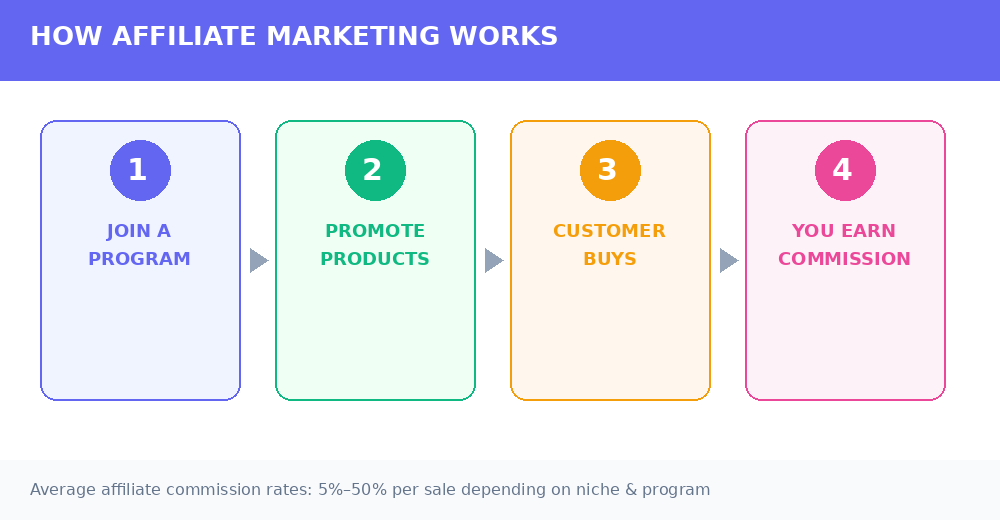
When you join an affiliate program, you receive a unique tracking link. Every time someone clicks that link and completes a qualifying action, the network records it and credits your account. According to Statista, affiliate marketing spending in the United States alone has grown to over $8 billion, reflecting how mainstream and lucrative this model has become.
Commission Structures You’ll Encounter
- Pay Per Sale (PPS) — You earn a percentage of each completed sale. Most common.
- Pay Per Lead (PPL) — You earn when a user signs up or fills out a form, even without buying.
- Pay Per Click (PPC) — You earn per click regardless of purchase. Less common today.
- Recurring Commissions — You earn every month the customer stays subscribed (common with SaaS products).
📌 Related: The Best Affiliate Traffic Strategies
Step 1: Choose Your Niche
Your niche is the specific topic or market you’ll focus on. Choosing the right niche is arguably the most important decision you’ll make as an affiliate marketer — it determines your audience, your content, and the products you promote.
The 3 Criteria for a Profitable Affiliate Niche
- Passion + Knowledge — You’ll be creating a lot of content. Picking a topic you genuinely enjoy makes this sustainable.
- Audience Demand — Use tools like Ahrefs’ free keyword generator to verify people are actively searching in your niche.
- Monetisation Potential — There must be affiliate programs with decent commission rates. Check if brands in the niche run affiliate programs before committing.
Best Niches for Affiliate Marketing
- 💰 Personal Finance & Investing
- 💻 Software & SaaS Tools
- 🏋️ Health, Fitness & Weight Loss
- ✈️ Travel & Lifestyle
- 🎓 Online Education & Courses
- 🏠 Home Improvement & Smart Home
- 💄 Beauty & Skincare
✅ Pro Tip: Don’t try to compete across a broad niche. Start hyper-focused — instead of “fitness,” target “home workouts for busy moms over 40.” Narrow niches face less competition and convert better.
Step 2: Join the Right Affiliate Programs
Once you’ve chosen your niche, it’s time to find the products and programs you’ll promote. Not all affiliate programs are created equal — commission rates, cookie durations, and payment terms vary widely.
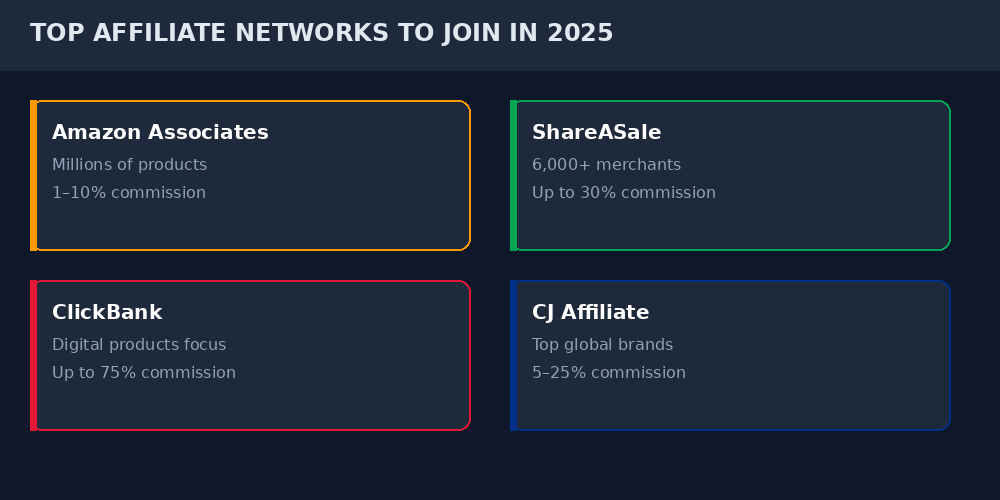
Top Affiliate Networks for Beginners
1. Amazon Associates — The largest and most beginner-friendly program. With millions of products, you can find something in virtually any niche. Commission rates are 1–10% but conversion is high because customers trust Amazon. Learn more at the Amazon Associates official site.
2. ShareASale — A massive affiliate network hosting 6,000+ merchant programs across nearly every niche. It’s free to join and has a reliable payment system.
3. ClickBank — Specialises in digital products like e-books, online courses, and software. Commission rates can reach 50–75%, making it one of the highest-paying options.
4. CJ Affiliate (formerly Commission Junction) — Home to major global brands. Ideal once you have some traffic, as many merchants have higher approval thresholds.
What to Look for in an Affiliate Program
- Commission rate of at least 10–20% for physical products, 30–50% for digital
- Cookie duration of 30+ days (longer means more chances to earn)
- Reliable monthly payments via direct deposit or PayPal
- Quality marketing materials (banners, product images, email swipes)
- A responsive affiliate manager you can contact for support
📌 Related: Best Affiliate Programs for Beginners (Reviewed & Ranked)
Step 3: Build Your Platform
Your platform is where you’ll publish content and send traffic. As a beginner, you have several options — each with its own pros and cons.
Option A: Blog / Website (Recommended)
A self-hosted WordPress blog is the gold standard for affiliate marketers. You own your content, build long-term SEO authority, and aren’t subject to algorithm changes. According to Neil Patel’s affiliate marketing guide, bloggers who produce consistent content typically see exponential traffic growth after 12–18 months.
Option B: YouTube Channel
Video is one of the highest-converting formats for affiliate marketing. Tutorial videos, unboxings, and product reviews drive enormous click-through rates on affiliate links in the description.
Option C: Email List
Building an email list lets you communicate directly with your audience. HubSpot reports an average return of $36 for every $1 spent on email marketing — the highest ROI of any digital channel.
⚠️ Important: Don’t build on every platform at once. Pick ONE primary channel, master it, and only expand once you’re generating consistent income.
Step 4: Create High-Converting Content
Content is the engine of affiliate marketing. The goal is to create content that ranks in search engines, builds trust with readers, and naturally weaves in your affiliate recommendations.
The 5 Best Content Formats for Affiliate Marketers
- Product Reviews — In-depth, honest reviews of a single product. High buyer intent.
- Comparison Posts — Pitting two products against each other. Converts extremely well.
- Best-of Lists — Roundups of top products in a category.
- How-To Tutorials — Step-by-step guides that solve a problem and recommend a tool.
- Resource Pages — A curated list of all the tools and products you personally use and recommend.
Step 5: Drive Targeted Traffic
Content without traffic is like a billboard in the middle of the desert. Here are the most effective traffic strategies for affiliate marketers.
Search Engine Optimisation (SEO)
SEO is the most powerful long-term traffic source for affiliate sites. Focus on long-tail keywords with clear purchase intent — “best budget noise-cancelling headphones under $100” will convert far better than just “headphones.”
Pinterest is a visual search engine particularly powerful for niches like food, home décor, fashion, and personal finance. Consistent pinning can drive significant traffic at no cost.
Email Marketing
Once you have subscribers, you own that traffic. A weekly newsletter with genuine value can consistently generate affiliate revenue independent of Google rankings.
📌 Related: SEO for Affiliate Marketing: How to Rank Your Posts and Double Your Commissions
Pro Tips to Earn Faster
- Promote products you actually use. Authenticity is your most valuable asset.
- Focus on recurring commissions. SaaS tools pay every month — one customer can be worth hundreds over their lifetime.
- Build an email list from day one. Your list is an asset you own forever.
- Use comparison and “best of” content. These posts attract readers already in buying mode.
- Track everything. Identify which content, buttons, and placements drive the most sales.
- Reinvest early profits into better tools, faster hosting, or paid keyword research software.
Common Affiliate Marketing Mistakes to Avoid
- Promoting too many products at once. Focus on a handful of genuinely useful products.
- Ignoring SEO. Without organic traffic, you’ll always be at the mercy of paid ads.
- Not disclosing affiliate relationships. This is both an FTC requirement and a trust builder.
- Giving up too early. Most affiliate sites don’t see significant income until month 9–18.
- Choosing highest commission over best product. Disappointing your audience costs more than any commission.
Frequently Asked Questions
How much money can beginners make with affiliate marketing?
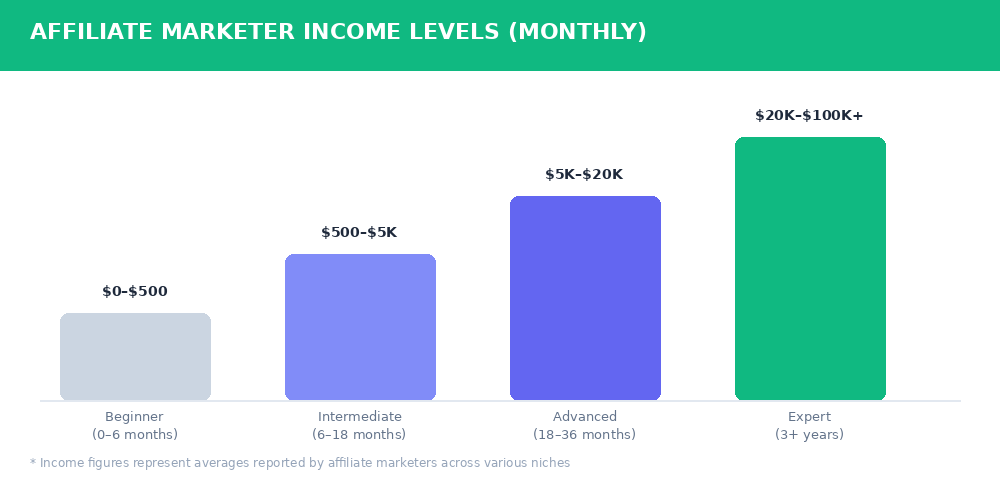
Beginners typically earn $0–$500/month in their first 6 months. With consistent effort, many affiliates reach $1,000–$5,000/month within 12–18 months. Top affiliates earn six figures annually.
Do I need a website to start affiliate marketing?
No — you can also use YouTube, social media, or email. However, a website gives you the most control and long-term earning potential.
Is affiliate marketing free to start?
Yes, you can start for free. However, investing in a domain ($15/year) and hosting ($3–10/month) gives you far better results long-term.
How long does it take to make money with affiliate marketing?
Expect 3–6 months before your first commission if starting from scratch. Most affiliates see consistent income after 12–18 months. Affiliate marketing rewards patience and consistency above all else.
Final Thoughts: Is Affiliate Marketing Worth It?
Absolutely. Affiliate marketing remains one of the most accessible, scalable, and sustainable ways to earn income online. The barriers to entry are virtually zero, the ceiling is unlimited, and the business model only gets more valuable as you build authority in your niche over time.
Choose a niche you’re passionate about, commit to creating genuinely helpful content, build an audience on a platform you control, and promote products you believe in. Do those things consistently for 12–18 months and you’ll be well on your way to real, recurring income.
Disclaimer: This post may contain affiliate links. As an affiliate, I may earn a commission from qualifying purchases at no additional cost to you.
Niche → offer → SEO cluster → Pinterest pins → first clicks. No fluff.