

Diversify Affiliate Income Streams in 2026: A Smart, Practical Playbook
Diversify affiliate income streams in 2026, and you build a business that can take a hit without going under. Keep everything tied to one platform, and you’re gambling on that platform’s goodwill every single month. Several platforms proved this the hard way this year, cutting commissions or changing terms with no warning — and the publishers who felt it hardest were the ones with nothing to fall back on.
Table of Contents
- Why Single-Platform Dependency Is a Bigger Risk in 2026
- What Diversifying Actually Means
- Step 1: Audit Where Your Income Actually Comes From
- Step 2: Choose Two or Three Channels That Complement Each Other
- Step 3: Build Owned Assets, Not Just Rented Traffic
- Step 4: Diversify Within Networks Too
- A Realistic Timeline for Diversifying Without Losing Momentum
- Common Mistakes When Diversifying Affiliate Income
- FAQ
Why Single-Platform Dependency Is a Bigger Risk in 2026
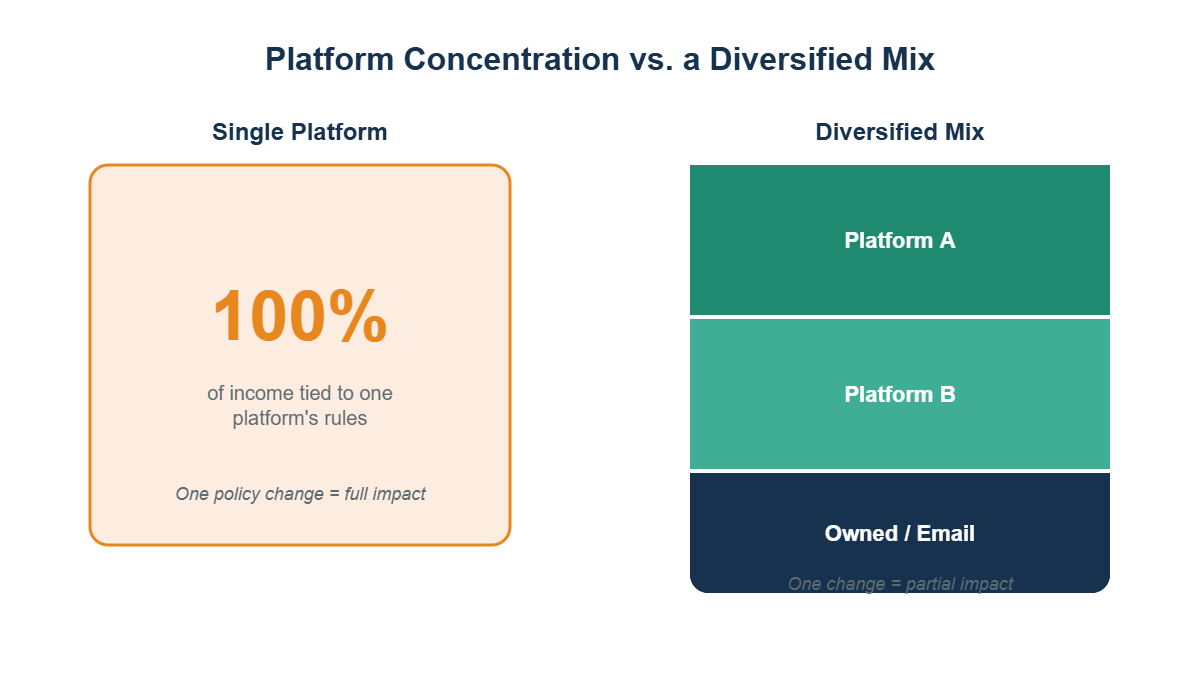
Affiliate platforms are businesses, and businesses adjust their economics when they need to. Commission structures, cookie windows, payout thresholds, and even entire program categories can change with little warning. TikTok Shop is the clearest example from this year: the platform cut affiliate commission caps in June 2026 with no transition window, dropping typical creator payouts from around 20% to 10-15% in several categories overnight.
When one platform accounts for the bulk of your revenue, you have no leverage and no cushion. You find out about a cut the same day everyone else does, and by then it’s already affecting your next payout. This isn’t a reason to panic or to abandon a platform that’s working well for you — it’s a reason to treat diversifying your affiliate income as an ongoing habit rather than a one-time project you’ll get to eventually.
What Diversifying Actually Means
A lot of advice on this topic stops at “join more affiliate networks,” which misses the point. Joining five programs that all depend on the same traffic source, the same content format, and the same audience doesn’t reduce your risk much. If that traffic source dries up, all five income streams dry up together.
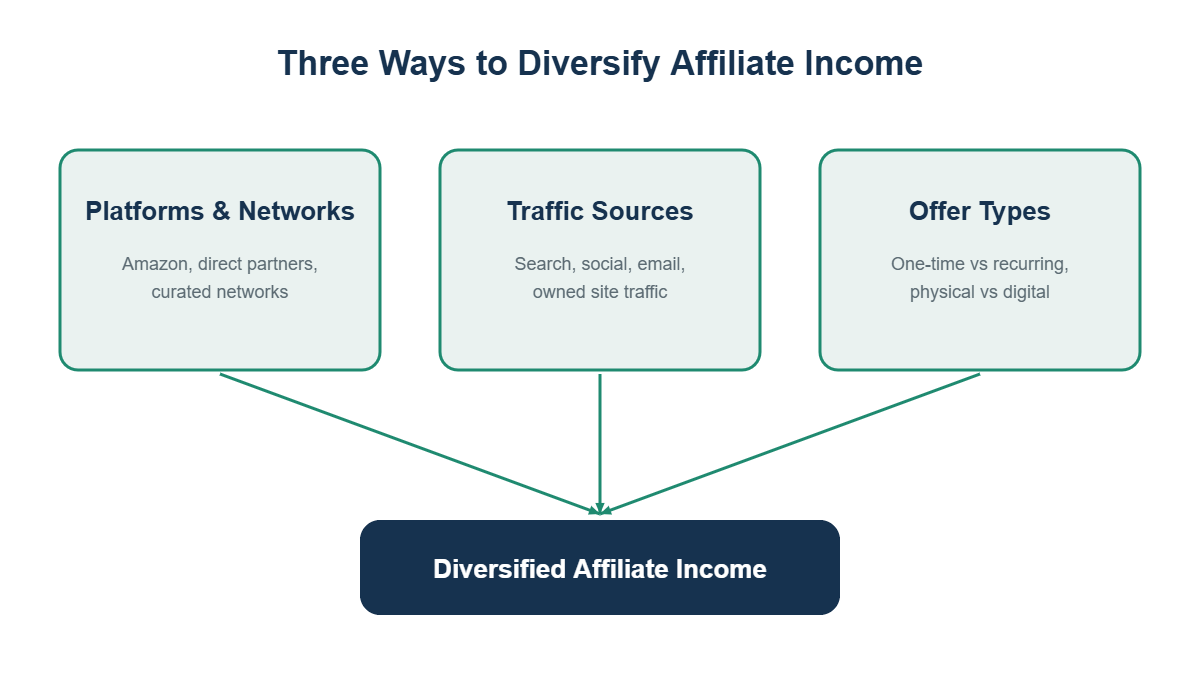
Real diversification happens across at least one of three dimensions: the platforms and networks you promote through, the traffic sources that bring people to your content, and the format of the offers themselves. Changing just one of these gives you some protection. Changing two or three gives you a business that can take a punch and keep operating while you adjust.
Step 1: Audit Where Your Income Actually Comes From
Before you add anything, look at what you already have. Pull your last three to six months of commission data and break it down by platform, by traffic source, and by content type. Most affiliates are surprised by how concentrated their income turns out to be once they actually chart it instead of estimating from memory.
Write down the percentage of total income tied to your single largest source. If that number is above 70-80%, you have a concentration problem worth addressing before anything else, regardless of how well that source is currently performing.
Step 2: Choose Two or Three Channels That Complement Each Other
Instead of spreading thin across ten platforms, pick a small number that genuinely differ from your current setup. If you rely heavily on Amazon-style low-commission, high-volume offers, look at direct partner programs or curated networks with higher payouts on fewer, better-matched products. If you’ve compared these before, our breakdown of Amazon, ClickBank, and direct partner programs is a useful starting point for weighing the trade-offs between volume-based and relationship-based affiliate income. It’s also worth reviewing a wider list of beginner-friendly affiliate networks if your current setup is limited to one or two programs.
The point isn’t to replace your main platform overnight. It’s to have a second and third channel already generating some income, so that if your primary source takes a hit, you’re not starting from zero while you figure out what’s next.
Step 3: Build Owned Assets, Not Just Rented Traffic
Platforms you don’t control — social feeds, marketplace search results, algorithm-driven discovery — can change the rules on you at any time. Assets you own, like an email list or a site with its own direct traffic, are the closest thing affiliates have to a stable foundation. As Forbes noted earlier this year, an owned list is one of the few assets that keeps its value regardless of what any single platform decides to do next.
This doesn’t mean abandoning social or marketplace traffic. It means treating those channels as acquisition tools that feed something you own, rather than as the whole strategy. If you don’t already have a system for this, our email funnel guide walks through turning one-time readers into a list you control.
Step 4: Diversify Within Networks Too
Even inside a single network, you can reduce risk by not letting one merchant or one product category carry most of your commissions. If a top-performing merchant leaves the network or slashes its rate, having five other merchants in the mix softens the blow considerably compared to having one merchant responsible for half your income.
This is especially relevant for recurring commission products, where a single strong subscription offer can quietly become the backbone of your income without you noticing until the terms change. Whichever platforms and merchants you add, remember disclosure obligations travel with you across every one of them — the FTC’s endorsement guidance applies no matter how many programs you’re running.
A Realistic Timeline for Diversifying Without Losing Momentum
You don’t need to overhaul everything this month. A reasonable pace looks like this: spend the first few weeks auditing your current income sources, then pick one new channel to test over the next month while keeping your existing content running as normal. Once that channel is producing some income, even modestly, add a second one rather than trying to launch several at once.
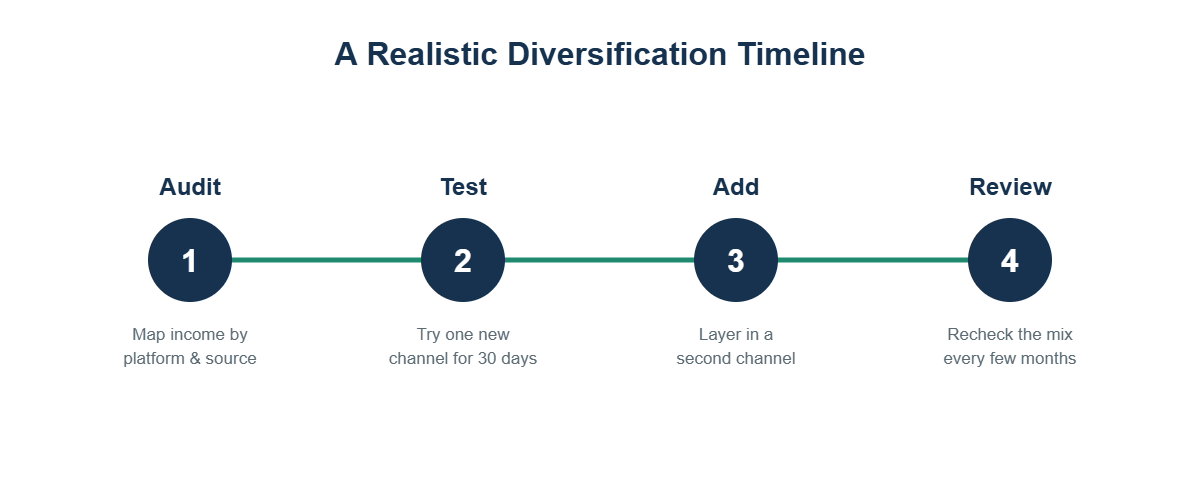
Diversifying too fast tends to spread your time so thin that nothing gets enough attention to actually work. Diversifying too slowly leaves you exposed for longer than necessary. Aim for steady, deliberate additions over two to three months rather than a single dramatic pivot.
Common Mistakes When Diversifying Affiliate Income
If you only take one step to diversify affiliate income streams in 2026, make it this: stop treating your biggest platform’s current terms as permanent. The mistakes below are what usually derail people once they start.
The most common mistake is treating diversification as a one-time checklist instead of an ongoing practice. Programs and platforms keep changing, so revisiting your income mix every few months should become a habit, not a project you close out and forget.
Another common mistake is adding channels that require an entirely new skill set or content format all at once, which stalls momentum. Where possible, extend what’s already working rather than starting completely from scratch. And finally, some affiliates diversify their platforms but keep promoting the same narrow set of products, which doesn’t actually reduce their exposure to a single merchant’s decisions.
FAQ
How many affiliate platforms should I realistically be on?
There’s no fixed number, but two to three well-matched channels that you can actually maintain tend to work better than five or six you can only half-manage. Quality of fit matters more than quantity.
Will diversifying hurt my income in the short term?
It can slow growth on your primary channel slightly while you split attention, which is normal. The goal is medium-term stability, not a short-term income spike, so expect a small trade-off upfront in exchange for less risk later.
Should I diversify even if my current platform is performing well?
Yes. The best time to diversify affiliate income streams in 2026 is from a position of strength, not after a downturn forces your hand. Waiting until a platform cuts commissions or changes terms means you’re rebuilding under pressure instead of on your own schedule.
Is an email list really necessary for diversification?
It’s one of the few assets that stays fully under your control regardless of what any single platform does, which makes it a strong foundation to diversify around rather than an optional extra.
Platform dependency isn’t something you fix once and move on from — it’s something you manage continuously as the affiliate landscape keeps shifting. Start with an honest look at where your income actually comes from, add channels deliberately rather than all at once, and lean on assets you own so that no single platform’s decisions can define your business.