Email Marketing for Affiliate Marketers: The Complete 2025 Strategy Guide
Social media algorithms change overnight. Google updates can tank your rankings in a week. But your email list? Nobody can take that away from you. Email marketing is the single most reliable income engine for affiliate marketers — and yet most affiliates treat it as an afterthought rather than the foundation it should be.
In this complete guide, you’ll learn exactly how to build, grow, and monetise an email list that generates predictable affiliate commissions every single month — from choosing the right platform to writing emails that actually convert.
Table of Contents
- Why Email Is the #1 Channel for Affiliate Marketers
- The 5-Stage Affiliate Email Funnel
- Best Email Platforms for Affiliates in 2025
- How to Build Your Email List Fast
- Writing a High-Converting Welcome Sequence
- Broadcast Emails That Drive Affiliate Sales
- Watch: Email + Affiliate Strategy in Action
- Mistakes That Kill Your Email Revenue
- FAQ
Why Email Is the #1 Channel for Affiliate Marketers
The numbers don’t lie. According to HubSpot’s marketing statistics, email delivers an average ROI of $36 for every $1 spent — higher than SEO, social media, or paid advertising. For affiliate marketers specifically, email offers three advantages no other channel can match.
- You own the relationship. Unlike social followers or search rankings, your email list is an asset you own outright. No platform can shadow-ban you, change an algorithm, or restrict your reach overnight.
- You reach warm, pre-qualified buyers. Subscribers opted in because they want what you offer. Every email lands in the inbox of someone who already trusts you — that’s a conversion advantage no cold traffic source can replicate.
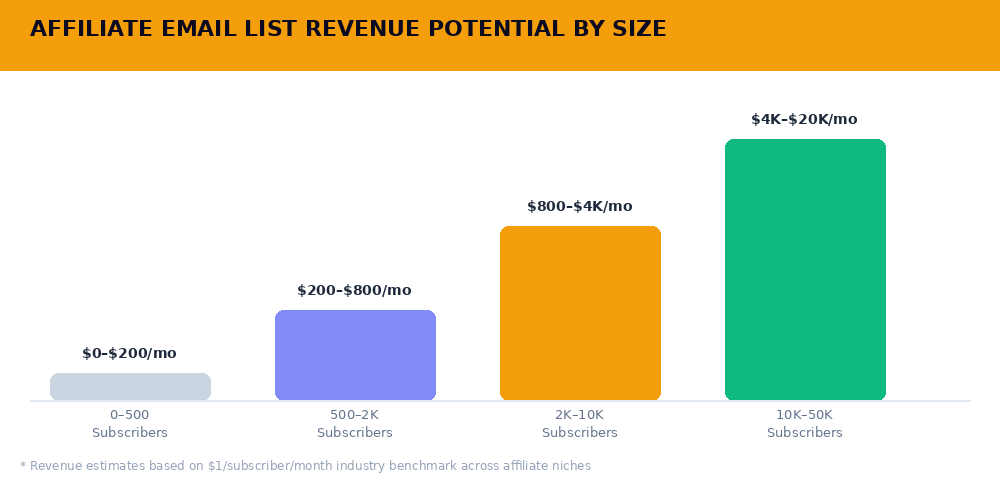
- It compounds over time. A list of 5,000 engaged subscribers earning $1/subscriber/month is $5,000 in recurring revenue — and it grows every single month you keep publishing content.
💡 Industry Benchmark: The affiliate marketing industry standard is $1 per subscriber per month for a well-monetised list. A focused list of 2,000 subscribers in a buying-intent niche can realistically generate $2,000/month in affiliate commissions.
The 5-Stage Affiliate Email Funnel
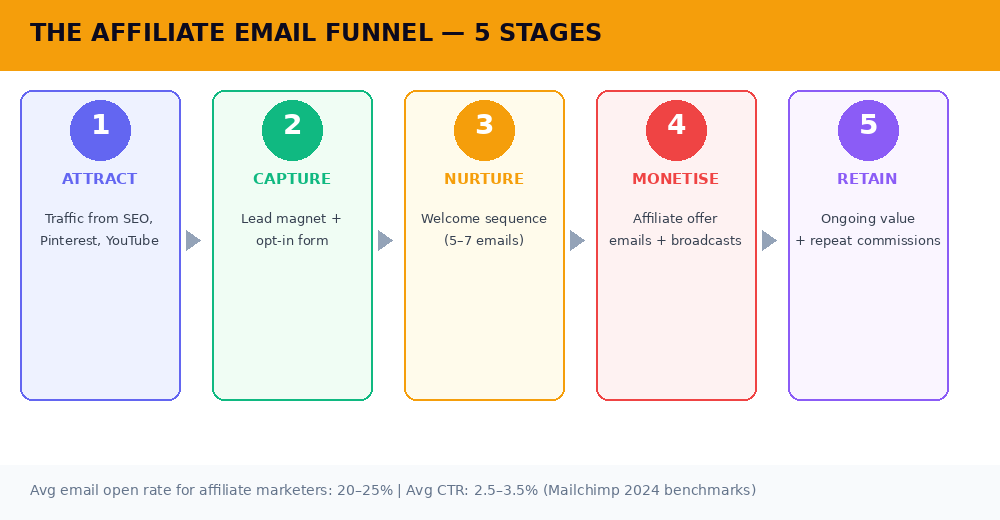
A successful affiliate email strategy isn’t just a list — it’s a system. Every subscriber goes through five stages, and your job is to engineer each transition deliberately.
Stage 1 — Attract
Drive targeted traffic to your opt-in page from SEO content, Pinterest, YouTube, or paid ads. The traffic source matters less than the intent — you want people who are actively looking for solutions your affiliate products solve.
Stage 2 — Capture
Convert visitors into subscribers using a lead magnet and opt-in form. Your lead magnet should solve one specific, immediate problem for your target audience. The more specific and valuable it is, the higher your opt-in rate. Aim for 30–50% opt-in rates on dedicated landing pages.
Stage 3 — Nurture
Deliver a 5–7 email welcome sequence that builds trust, establishes your authority, and warms the subscriber up before you make any affiliate offer. This sequence is the most important investment you’ll make in your email strategy — a well-written welcome sequence can generate 3–5× the revenue of a standalone promotional email.
Stage 4 — Monetise
Introduce affiliate offers through a mix of dedicated promotional emails, soft recommendations within value emails, and broadcast campaigns timed around product launches, seasonal promotions, and bonuses you create to incentivise purchases through your link.
Stage 5 — Retain
Keep subscribers engaged with consistent value — weekly tips, curated resources, case studies — so they stay on your list, keep opening your emails, and keep buying through your affiliate links month after month. Retention is where the real money is made.
📌 Related: Affiliate Marketing for Beginners: The Complete 2025 Step-by-Step Guide
Best Email Platforms for Affiliates in 2025
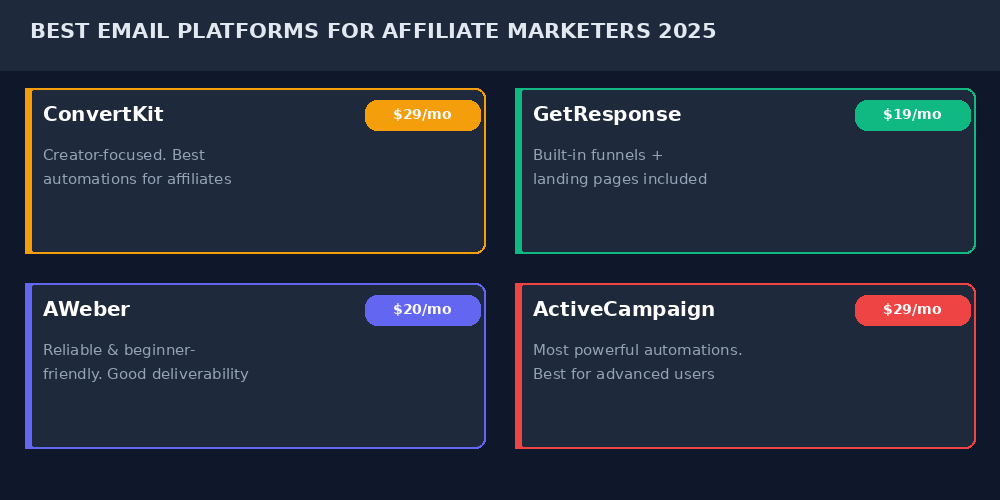
Not all email platforms are affiliate-friendly. Some (like Mailchimp) have strict policies against affiliate links in emails. Choose a platform built for creators and marketers from the start.
ConvertKit — Best for Creator-Affiliates
ConvertKit was built for creators and is widely regarded as the most affiliate-friendly major platform. Its visual automation builder makes it easy to set up tag-based sequences that segment subscribers based on their behaviour. Free plan available up to 1,000 subscribers. Paid plans start at $29/month.
GetResponse — Best All-in-One Option
GetResponse includes built-in landing page and funnel builders alongside its email marketing tools — making it a great value choice for affiliates who want everything in one platform. Starts at $19/month and includes webinar hosting on higher tiers.
AWeber — Best for Beginners
AWeber has been affiliate-friendly since its founding and has excellent deliverability rates. Its drag-and-drop editor and pre-built templates make it beginner-friendly. Free plan up to 500 subscribers, paid from $20/month. According to AWeber’s deliverability page, they maintain 99%+ inbox placement rates.
ActiveCampaign — Best for Advanced Automations
ActiveCampaign is the most powerful automation platform on this list. Its CRM features and deep segmentation capabilities make it ideal for affiliates who want to build sophisticated behavioural sequences. Best suited for established lists generating $2,000+/month. Starts at $29/month.
📌 Related: Keyword Research for Affiliate Sites: The Complete 2025 Playbook
How to Build Your Email List Fast
The fastest list-building strategy is a combination of a high-converting lead magnet and consistent traffic to your opt-in page. Here’s what actually works in 2025.
Create an Irresistible Lead Magnet
Your lead magnet must solve one specific, urgent problem for your ideal subscriber. The best-performing lead magnets for affiliate sites are checklists, swipe files, mini-courses, resource lists, and comparison guides. Avoid vague “sign up for updates” offers — nobody signs up for updates anymore.
High-converting lead magnet examples by niche:
- Personal Finance: “The 5 Accounts I Use to Earn 4% on My Savings (Free Checklist)”
- Email Marketing: “7-Day Welcome Sequence Template (Copy & Paste)”
- Affiliate Marketing: “The 20 Highest-Paying Affiliate Programs in 2025 (Instant PDF)”
- Fitness: “4-Week Home Workout Plan — No Equipment Needed (Free Download)”
Drive Traffic to Your Opt-In Page
Add opt-in forms to your highest-traffic blog posts, create dedicated landing pages for your lead magnet, add a link-in-bio on social profiles, and pin a tweet/post about your lead magnet to the top of your social profiles. Every piece of content you publish should have a clear path to your email list.
Writing a High-Converting Welcome Sequence
Your welcome sequence is the most read, most clicked, and most revenue-generating set of emails you’ll ever write. Subscribers are most engaged in the first 7 days after joining — use this window to build maximum trust before making your first affiliate offer.
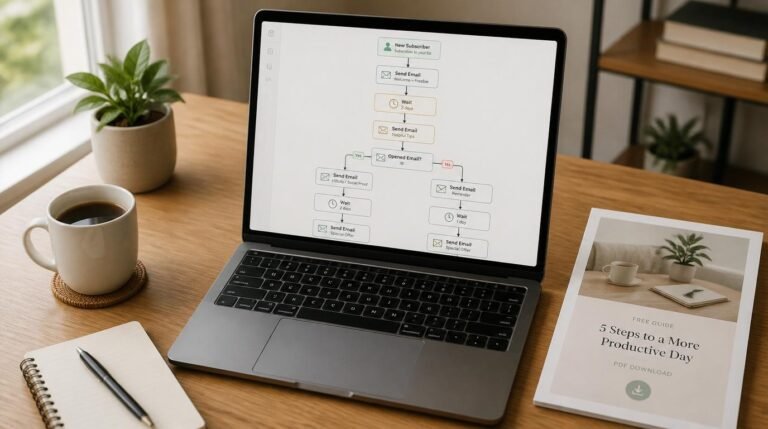
The 5-Email Welcome Sequence Framework
- Email 1 — Deliver & Welcome (Day 0): Deliver the lead magnet immediately. Introduce yourself briefly, set expectations for what’s coming, and ask one engagement question to start the conversation.
- Email 2 — Your Story (Day 1): Share why you got into this niche, a struggle you overcame, and a specific result you achieved. This humanises you and builds emotional connection.
- Email 3 — Pure Value (Day 2): Send your best tip, hack, or piece of advice with zero selling. This reinforces your credibility and gets subscribers into the habit of opening your emails.
- Email 4 — Social Proof + Soft Intro (Day 4): Share a success story (yours or a reader’s). Mention the tool or product that made it possible — this is your soft affiliate introduction.
- Email 5 — The Offer (Day 6): Make your first affiliate recommendation explicitly. Focus on the transformation the product enables, not its features. Include a clear CTA and your affiliate link.
Broadcast Emails That Drive Affiliate Sales
Beyond your welcome sequence, your ongoing broadcasts keep your list warm and generate consistent affiliate revenue. The best-performing broadcast email types for affiliates are:
- The “Tool I Use” Email: Share a tool you personally use, explain the specific problem it solves for you, and link to it via your affiliate link. Authentic and high-converting.
- The “Case Study” Email: Walk through a specific result you or a reader achieved, credit the product that helped, and link out. Story-based emails consistently outperform feature-based promotions.
- The “Limited Offer” Email: When a product you promote runs a sale or bonus, email your list with a clear deadline. Urgency is the most powerful conversion trigger in email marketing.
- The “Comparison” Email: “I tested X vs Y so you don’t have to” emails generate high clicks because they provide genuine value while leading to a clear affiliate recommendation.
- The “Resource Roundup” Email: Weekly or monthly curated lists of tools, articles, and tips. Low-pressure, high-value, with multiple soft affiliate touches throughout.
📌 Related: The Best Affiliate Traffic Strategies: SEO, Pinterest & Email
Watch: Email Marketing + Affiliate Strategy in Action
This video walks through a real-world email and affiliate marketing strategy — combining list-building tactics with automation sequences that generate commissions on autopilot. A must-watch for anyone serious about building an affiliate email income stream.
How To Make Money With Emails! — Affiliate Marketing + Email Strategy
Mistakes That Kill Your Email Affiliate Revenue
- Emailing only when you want to sell something. If subscribers only hear from you when you want their money, they’ll stop opening your emails. Send value-first emails consistently — aim for at least 2–3 value emails for every promotional email.
- Using Mailchimp or other affiliate-restrictive platforms. Mailchimp’s terms of service restrict affiliate links in certain contexts. Use an affiliate-friendly platform from the start to avoid account suspension.
- Not segmenting your list. Sending the same email to everyone on your list regardless of their interests or behaviour is leaving money on the table. Even basic segmentation (buyers vs non-buyers, topic interest) can double your click-through rates.
- Ignoring deliverability. Even perfectly written emails generate zero revenue if they land in spam. According to Litmus’s email deliverability research, 1 in 6 legitimate emails never reaches the inbox. Warm up new domains, clean your list regularly, and monitor your sender reputation.
- Promoting too many products. Affiliates who promote a new product every week train their subscribers to ignore affiliate emails. Focus on 3–5 core products you genuinely believe in and promote them consistently.
- Not tracking what works. Open rate, click rate, and revenue per email are your three most important metrics. Review them weekly and ruthlessly cut what doesn’t perform.
Frequently Asked Questions
How many subscribers do I need to make money with email affiliate marketing?
You can make your first affiliate sale with as few as 50–100 highly targeted subscribers. The quality of your list and the relevance of your offers matter far more than the size. Focus on getting the right people on your list rather than chasing numbers.
How often should I email my affiliate list?
The optimal frequency depends on your niche and audience, but once per week is the standard starting point. Emailing less than once a week risks subscribers forgetting who you are. More than three times per week risks fatigue and unsubscribes. Test your specific audience to find the right cadence.
Can I use affiliate links in emails?
Yes, but check your email platform’s terms. ConvertKit, GetResponse, AWeber, and ActiveCampaign all allow affiliate links. Mailchimp has restrictions. Always disclose affiliate relationships clearly — include a brief disclosure at the bottom of every email containing affiliate links.
What is a good open rate for affiliate email marketing?
Industry average open rates are 20–25% for most niches. An engaged affiliate list should aim for 25–40%. If your open rate falls below 15%, focus on improving your subject lines, cleaning your list of inactive subscribers, and sending more value-forward content.
How do I grow my email list without paid ads?
The most effective free list-building tactics are SEO-driven blog content with embedded opt-in forms, Pinterest driving traffic to lead magnet landing pages, YouTube video descriptions with opt-in CTAs, and social media bio links. Prioritise whichever traffic channel you’re already building.
Final Thoughts: Your Email List Is Your Most Valuable Asset
Every affiliate marketer who has built a sustainable, long-term income has an email list at the centre of their business. It’s the channel that converts best, pays most reliably, and compounds in value over time in a way that no social platform or search ranking ever can.
Start building your list today — even if it’s just one opt-in form on your best blog post and a simple 3-email welcome sequence. The best time to start was when you launched your site. The second best time is right now.
Disclaimer: This post may contain affiliate links. As an affiliate, I may earn a commission from qualifying purchases at no additional cost to you.