

Best Affiliate Networks for Beginners: Top 8 Reviewed & Compared (2025)
Choosing the wrong affiliate network when you’re starting out is one of the most common — and most costly — beginner mistakes. Apply to the wrong programs, get rejected, and you lose weeks of momentum. Join a network with low commissions or poor tracking, and you leave hundreds of dollars on the table. This guide cuts through the noise and shows you exactly which affiliate networks are worth your time in 2025 — and which ones to skip until you’re more established.
Table of Contents
- What Is an Affiliate Network?
- Top 8 Affiliate Networks for Beginners (Reviewed)
- Understanding Commission Structures
- How to Choose the Right Network for Your Niche
- How to Get Approved Faster
- Watch: Best Affiliate Networks Compared
- FTC Compliance: What Every Affiliate Must Know
- Common Network Mistakes to Avoid
- FAQ
What Is an Affiliate Network?
An affiliate network is a platform that acts as the middleman between affiliate marketers (publishers) and the brands or companies (merchants) who want to sell their products. Instead of managing individual affiliate partnerships directly, brands list their programs on a network, and affiliates can apply to multiple programs in one place.
The network handles the technical infrastructure: tracking clicks and conversions via unique affiliate links, calculating commissions accurately, processing payments, and providing reporting dashboards. For beginners, starting with a reputable network means you’re protected by a third party that enforces payment terms and resolves disputes — something you don’t get with direct brand partnerships.
💡 Key Fact: According to Statista, 81% of brands use affiliate programs, with most running through established networks. There’s never been more opportunity for new affiliates to find profitable programs to promote.
Top 8 Affiliate Networks for Beginners (Reviewed)
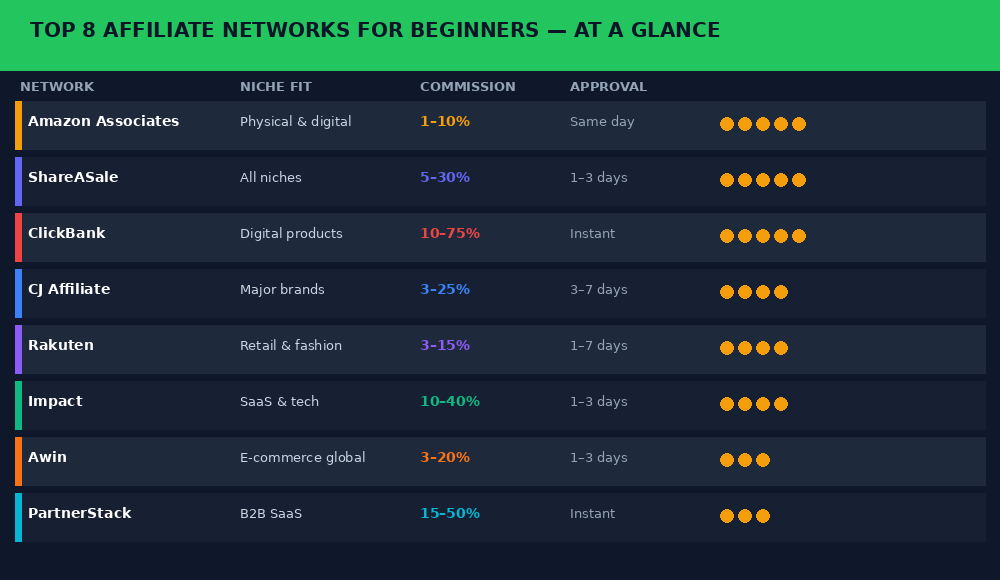
1. Amazon Associates — Best Overall for Beginners
Amazon Associates is the world’s largest affiliate program and the easiest to get started with. With millions of products across every conceivable category, there’s a relevant product for virtually any niche. Approval is straightforward — you just need an active website or social account. Commission rates range from 1% to 10% depending on category, with the cookie window lasting 24 hours (or 90 days if an item is added to cart). The low commission rates are offset by Amazon’s unmatched conversion rate — people are already primed to buy on Amazon. Best for: Beginners in any niche who want instant approval and reliable payments.
2. ShareASale — Best for Niche Diversity
ShareASale hosts over 6,000 merchant programs spanning virtually every niche — from fashion and home décor to software and B2B services. Each merchant sets their own commission rates (typically 5–30%) and cookie durations. The platform’s search and filter tools make it easy to find high-quality programs in your niche. Approval varies by merchant, but many programs on ShareASale have auto-approval for new affiliates. Best for: Affiliates who want to promote a wide variety of products and need easy access to niche-specific programs.
3. ClickBank — Best for Digital Products & High Commissions
ClickBank specialises in digital products — online courses, e-books, software, and membership sites — and is famous for its high commission rates, often ranging from 30% to 75%. Most products have instant approval, making it one of the most beginner-accessible networks available. The marketplace has thousands of products, but quality varies significantly, so always vet products carefully before promoting. Best for: Beginners in the make-money-online, health, and self-improvement niches who want high commissions without approval friction.
4. CJ Affiliate (Commission Junction) — Best for Big Brand Access
CJ Affiliate is one of the oldest and most established networks, home to major global brands including Lowe’s, Office Depot, Overstock, and hundreds more. Commission rates typically range from 3% to 25% with cookie durations of 7–45 days. Individual merchant applications are required and many brands have traffic thresholds before they’ll approve new affiliates. Best for: Affiliates who have existing traffic and want access to recognisable brand names that boost conversion rates.
5. Impact — Best for SaaS & Technology Niches
Impact has become the go-to network for software, SaaS, and technology companies. Programs include Canva, Semrush, Squarespace, and hundreds of other high-value tech brands. Commission rates are typically 10–40%, and many programs offer recurring commissions — meaning you earn every month a customer stays subscribed. Best for: Content creators and bloggers in the marketing tools, software, and productivity niches.
6. PartnerStack — Best for B2B SaaS Recurring Commissions
PartnerStack focuses exclusively on B2B SaaS products — tools used by businesses rather than consumers. The advantage is recurring commissions of 15–50% that keep paying month after month for the lifetime of a customer. Programs include ConvertKit, Monday.com, and dozens of other established platforms. Best for: Affiliates targeting business owners, marketers, or entrepreneurs with high-value software recommendations.
7. Awin — Best for International & Retail Brands
Awin is Europe’s largest affiliate network with a strong global presence. It hosts 25,000+ advertiser programs across retail, finance, travel, and e-commerce. Notable brands include Etsy, HP, and Under Armour. There’s a small $5 deposit required to join that’s refunded with your first payment. Best for: Affiliates targeting European audiences or those in retail, fashion, and travel niches.
8. Rakuten Advertising — Best for Premium Retail
Rakuten is one of the most selective networks, hosting premium brands like Walmart, Best Buy, and New Balance. Approval requirements are higher, making it better suited to established affiliates with consistent traffic. Commissions range from 3% to 15% with reliable monthly payments. Best for: Affiliates with established authority sites who want access to premium retail brands with high conversion rates.
📌 Related: Affiliate Marketing for Beginners: The Complete 2025 Step-by-Step Guide
Understanding Commission Structures
Not all affiliate commissions work the same way. Understanding the different structures helps you choose programs that align with your traffic patterns and conversion goals.
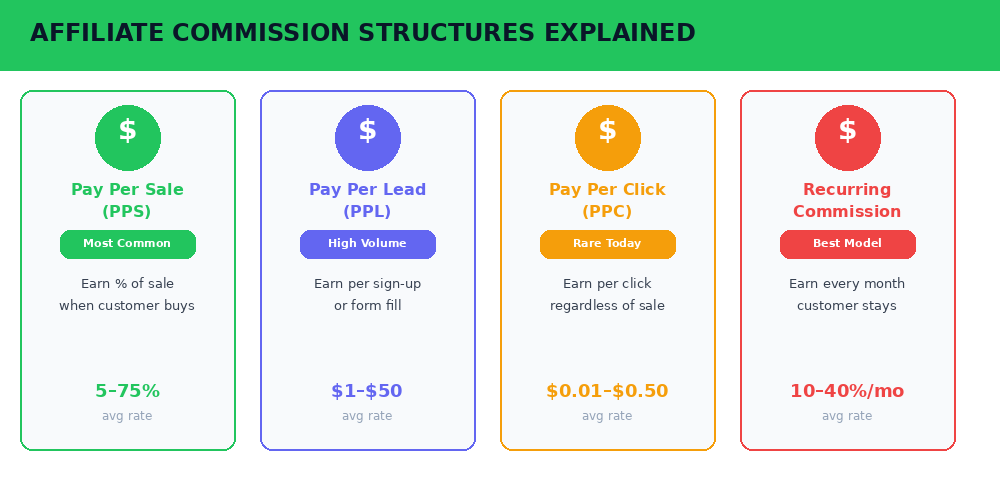
Pay Per Sale (PPS) is by far the most common structure. You earn a percentage of the sale price each time a customer buys through your link. Rates vary from 1% for physical products to 75% for some digital products. PPS works best when you’re creating buyer-intent content like product reviews and comparison posts.
Pay Per Lead (PPL) pays you when a user completes an action short of purchasing — filling out a form, signing up for a free trial, or creating an account. These convert easier than sales (no credit card required), but pay less per conversion. Common in insurance, finance, and SaaS niches.
Recurring commissions are the holy grail of affiliate marketing. Promote a SaaS tool or subscription service, and you earn a commission every month that customer remains subscribed. A single referred customer can generate $50–$500+ in lifetime commission value. Prioritise recurring programs wherever possible in your niche.
How to Choose the Right Network for Your Niche
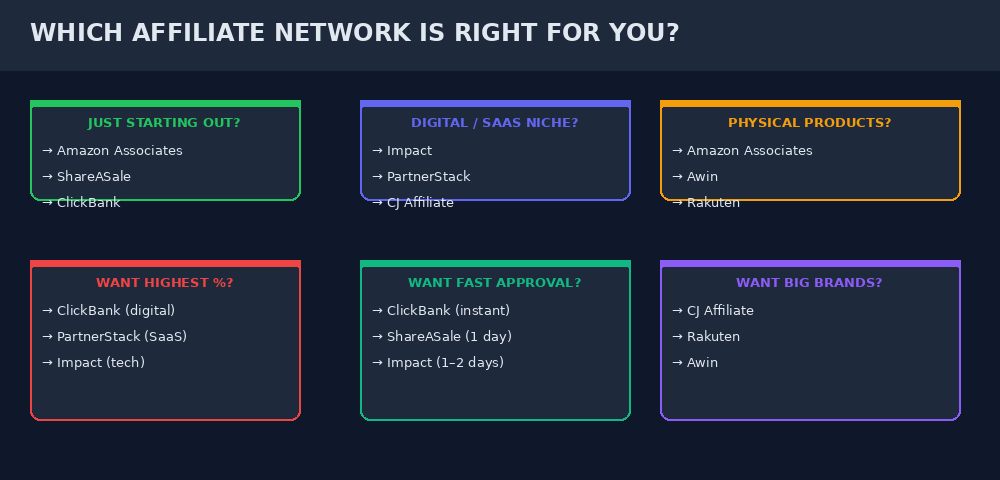
The right network depends on your niche, audience, and content strategy. Use these simple rules:
- Physical product niche (home, kitchen, sports, beauty): Start with Amazon Associates + Awin or Rakuten for brand diversity.
- Digital product niche (courses, software, online tools): ClickBank for high commissions + Impact and PartnerStack for SaaS.
- Broad/mixed niche blog: ShareASale as your primary network — the 6,000+ merchants mean you’ll find relevant programs for almost any content.
- B2B or marketing niche: PartnerStack and Impact for recurring SaaS commissions. CJ Affiliate for major brand access once you have traffic.
- Finance or insurance niche: CJ Affiliate and direct brand partnerships — most major financial institutions run their own programs or list on CJ.
📌 Related: Keyword Research for Affiliate Sites: Find Low-Competition Keywords That Convert
How to Get Approved for Affiliate Programs Faster
Many beginners get rejected from affiliate programs not because their site is bad, but because they make easily avoidable application mistakes. Here’s how to maximise your approval rate from day one.
- Have a complete, professional website before applying. Even 5–10 well-written posts are enough. Applications from sites with zero content get rejected automatically at most networks.
- Match your niche to the merchant’s products. A fitness blog applying to a software merchant will be rejected. Apply only to programs directly relevant to your audience.
- Complete your network profile fully. Many affiliates leave their marketing methods, promotional channels, and traffic sources blank. A complete profile signals a serious publisher.
- Write a personalised application note. Where merchants allow custom notes, explain specifically how you plan to promote their product, what audience you serve, and why it’s a good fit. A few sentences dramatically improves approval rates.
- Start with auto-approval programs. Build your track record and commission history on networks like ClickBank and ShareASale (many merchants have auto-approval) before applying to selective programs on CJ or Rakuten.
Watch: Best Affiliate Networks for Beginners Compared
This video breaks down the top affiliate networks side by side — covering commission rates, ease of approval, payment terms, and which networks are best suited to different niches and experience levels.
7 Best Affiliate Networks You NEED To Join — Top Networks for Beginners Reviewed
FTC Compliance: What Every Affiliate Must Know
Affiliate marketing compliance isn’t optional — it’s a legal requirement in the United States and most countries. The FTC’s Endorsement Guides require that you clearly disclose your affiliate relationships whenever you promote a product for compensation. Failure to disclose can result in fines of up to $51,744 per violation.
Disclosure Requirements at a Glance
- Placement: Disclosures must appear before your first affiliate link — not buried at the bottom of the page.
- Clarity: Must be in plain language. “This post contains affiliate links” is acceptable. “#ad” alone on social media may not be sufficient.
- Visibility: Must be noticeable — not hidden in small print or behind a collapsed section.
- Consistency: Required on every page, post, video, and social media update that contains affiliate links — without exception.
Most reputable affiliate networks also require disclosure as part of their terms of service. Violating network terms can result in account termination and forfeiture of unpaid commissions. According to the FTC’s consumer guidance, the standard for clear disclosure is whether a reasonable consumer would notice and understand it.
📌 Related: Email Marketing for Affiliate Marketers: Build and Monetise Your List
Common Affiliate Network Mistakes to Avoid
- Joining too many networks at once. Focus on mastering 1–2 networks before expanding. Spreading yourself across five networks with no traction on any of them is a common beginner trap.
- Promoting products without testing them. Your reputation depends on the quality of what you recommend. Whenever possible, use the product before promoting it. Readers trust authentic recommendations far more than generic write-ups.
- Ignoring cookie duration. A 24-hour cookie (like Amazon’s) means you only earn if the customer buys within 24 hours of clicking your link. A 90-day cookie gives you 90 days. When comparing similar commission rates, always favour longer cookie windows.
- Not reading the programme terms. Each affiliate programme has its own rules about where you can promote links (some prohibit paid ads, email, or social media). Violating these terms gets you removed without warning.
- Chasing commission rate over conversion rate. A programme paying 50% commission is worthless if the product doesn’t convert. A programme paying 8% on a product your audience loves will consistently outperform it.
Frequently Asked Questions
Which affiliate network pays the most?
ClickBank and PartnerStack consistently offer the highest commission rates (30–75% and 15–50% respectively). However, high commission rates don’t always mean high earnings — conversion rate, product quality, and audience fit matter more than the percentage alone.
How many affiliate networks should a beginner join?
Start with 1–2 networks maximum. Amazon Associates plus one niche-specific network (ShareASale or ClickBank depending on your niche) is the ideal starting point. Add networks as your traffic grows and you have a clearer picture of what your audience buys.
Are affiliate networks free to join?
Yes — Amazon Associates, ShareASale, ClickBank, CJ Affiliate, Impact, and PartnerStack are all free to join. Awin requires a refundable $5 deposit. Rakuten is free but selective about who they accept.
How long does it take to get paid by affiliate networks?
Most networks pay on a monthly basis once you reach the minimum payout threshold ($50–$100 on most platforms). Amazon Associates pays approximately 60 days after the end of the month in which the sale occurred. ClickBank and ShareASale can pay weekly or bi-weekly for established affiliates.
Can I join multiple affiliate programmes within the same network?
Yes — joining a network like ShareASale gives you access to thousands of individual merchant programs. You apply to each merchant separately, but they all pay through a single ShareASale account. This centralised structure is one of the biggest advantages of working with established networks.
Final Thoughts: The Right Network Accelerates Everything
The affiliate network you choose is the foundation every commission is built on. Start with Amazon Associates for instant approval and a broad product catalogue. Add ShareASale for niche diversity or ClickBank for high-commission digital products. As your site grows, layer in Impact, PartnerStack, or CJ Affiliate for premium brand access and recurring revenue potential.
Most importantly: pick your network, apply to 3–5 relevant programmes, create genuine content that recommends products your audience actually needs — and stay compliant with FTC disclosure rules from day one. That combination is what separates affiliate sites that build sustainable income from those that flame out in six months.
Disclaimer: This post may contain affiliate links. As an affiliate, I may earn a commission from qualifying purchases at no additional cost to you.