
Keyword Research for Affiliate Sites: The Complete 2025 Step-by-Step Playbook
Ask any successful affiliate marketer what separates sites that earn $50/month from those earning $5,000/month, and the answer is almost always the same: keyword research. Choosing the wrong keywords means writing hundreds of posts that Google ignores. Choosing the right ones means a single article can generate passive affiliate income for years.
This guide gives you the complete, step-by-step keyword research playbook built specifically for affiliate sites — from understanding search intent to finding your first buyer-intent keywords today, even if you’re starting from zero.
Table of Contents
- Why Keyword Research Makes or Breaks Affiliate Sites
- Understanding Search Intent for Affiliate Marketing
- The Best Keyword Research Tools in 2025
- Step-by-Step Keyword Research Process
- Finding the Affiliate Keyword Sweet Spot
- Stealing Keywords from Competitors
- Watch: Keyword Research in Action
- Common Keyword Research Mistakes
- FAQ
Why Keyword Research Makes or Breaks Affiliate Sites
Most beginner affiliate marketers write about topics they find interesting rather than topics people are actively searching for. The result? Months of content creation with near-zero organic traffic. Keyword research solves this by ensuring every piece of content you create is built around a real search query with real traffic potential.
But it goes deeper than just traffic. For affiliate sites, the type of keyword matters as much as the volume. A keyword getting 50 searches a month from people ready to buy will consistently outperform a keyword getting 5,000 searches from people just browsing. This is why search intent is the single most important concept in affiliate keyword research.
💡 Key Stat: According to Semrush’s keyword research data, long-tail keywords with buyer intent convert at 2.5× the rate of informational keywords — making keyword selection the highest-leverage activity for affiliate income.
Understanding Search Intent for Affiliate Marketing
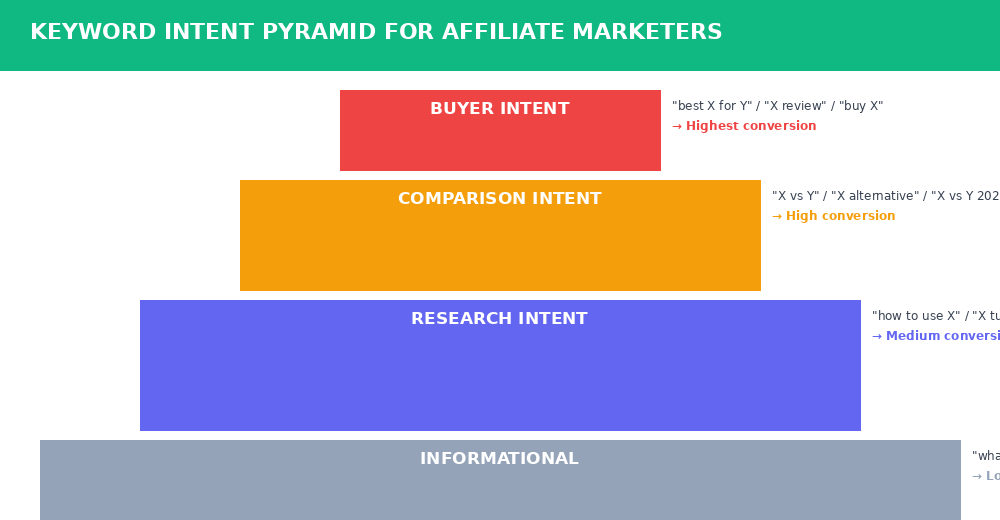
Every search query falls into one of four intent categories. As an affiliate marketer, your goal is to target the top two as your primary content — and use the bottom two to build topical authority and trust.
1. Buyer Intent Keywords (Highest Priority)
These are searches made by people ready to spend money. They already know what they want — they just need confirmation. Examples: “best email marketing software for bloggers,” “ConvertKit review 2025,” “buy Ahrefs subscription.” These keywords convert at the highest rate and should make up 40–50% of your affiliate content.
2. Comparison Intent Keywords (High Priority)
Searchers are evaluating options before buying. Examples: “Ahrefs vs Semrush,” “Bluehost vs SiteGround 2025,” “ConvertKit vs Mailchimp.” These posts perform exceptionally well for affiliate commissions because the reader is one decision away from buying.
3. Research Intent Keywords (Medium Priority)
Users are learning but not yet ready to buy. Examples: “how to use Ahrefs,” “what is keyword difficulty,” “how affiliate marketing works.” These posts build trust and topical authority, warm up cold readers, and can include soft affiliate recommendations.
4. Informational Keywords (Supporting Role)
Pure curiosity searches. Examples: “what is SEO,” “affiliate marketing meaning.” Useful for topical authority and internal linking but rarely convert directly. Use these sparingly and always link internally to your buyer-intent content.
📌 Related: Affiliate Marketing for Beginners: The Complete 2025 Step-by-Step Guide
The Best Keyword Research Tools in 2025
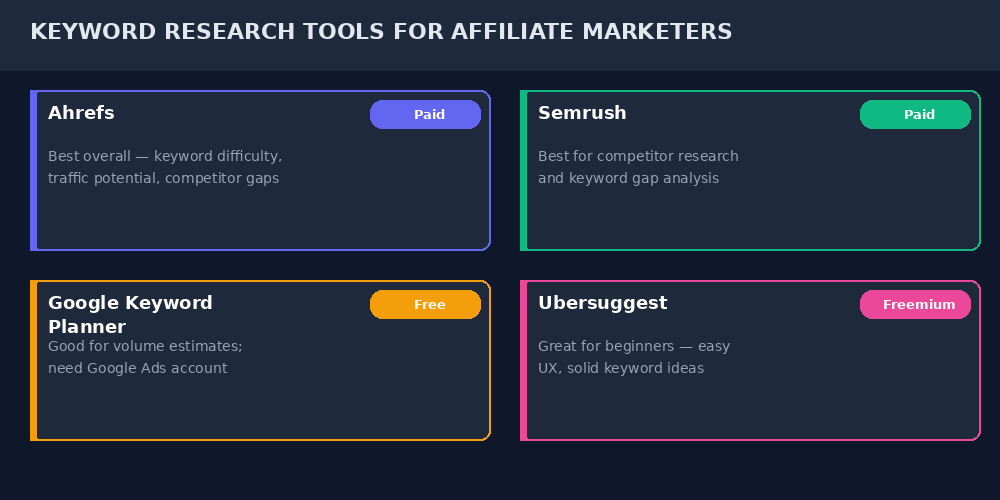
You don’t need every tool — you need the right one for your budget and stage. Here’s an honest breakdown of what actually works for affiliate keyword research.
Ahrefs (Best Overall — Paid)
Ahrefs is the gold standard for affiliate keyword research. Its Keywords Explorer gives you accurate search volume, keyword difficulty (KD), traffic potential, and parent topic data all in one view. The “Matching terms” and “Related terms” filters are invaluable for finding low-competition variations. Plans start at $129/month, but the ROI is positive for any affiliate site earning $500+/month.
Semrush (Best for Competitor Research — Paid)
Semrush’s Keyword Gap tool is unmatched for finding keywords your competitors rank for but you don’t. If you know which affiliate sites are crushing it in your niche, you can reverse-engineer their entire keyword strategy. Also excellent for tracking your rankings week over week.
Google Keyword Planner (Free — Good Starting Point)
Free with a Google account. Gives broad volume ranges rather than precise numbers, but it’s genuinely useful for discovering keyword clusters and validating niche demand before you invest in a paid tool. Combine it with Google Search Console once your site has traffic for a powerful free stack.
Ubersuggest (Best Free/Freemium Option)
Built by Neil Patel, Ubersuggest offers a clean UX and solid keyword ideas for beginners. The free tier allows a limited number of daily searches. A great starting point before committing to Ahrefs or Semrush.
Step-by-Step Keyword Research Process for Affiliate Sites
Step 1: Start With Your Niche’s Core Topics
List 5–10 “seed keywords” — broad terms that describe your niche. If your site is about email marketing tools, seeds might be: email marketing, email autoresponder, newsletter software, email list building. These aren’t the keywords you’ll target directly — they’re the starting point for finding hundreds of more specific, rankable keywords.
Step 2: Enter Seeds Into Your Keyword Tool
In Ahrefs Keywords Explorer, enter your seed keyword and go to “Matching terms.” Apply filters: KD max 20, volume min 100. Then scan for buyer-intent modifiers like best, review, vs, alternative, top, cheapest, discount. Export your list — you’ll often find 50–200 viable keywords from a single seed.
Step 3: Evaluate Each Keyword’s Real Competition
KD is a guide, not gospel. Always manually check the SERP for your target keyword. Look at the top 10 results: How many are from established authority sites? Are there any small blogs ranking? If a DR 20–40 site ranks on page one, that’s a green light. According to Backlinko’s keyword research guide, the actual SERP analysis is more reliable than KD scores alone.
Step 4: Map Keywords to Content Types
Each keyword maps to a specific content format. “Best email marketing software for small business” → Best-of list. “ConvertKit review” → Product review. “ConvertKit vs ActiveCampaign” → Comparison post. “How to set up an email autoresponder” → Tutorial. Matching keyword intent to content format is what separates affiliate sites that convert from those that don’t.
Step 5: Build a Content Calendar Around Keyword Clusters
Group related keywords into clusters — a pillar post (e.g., “Best Email Marketing Software”) surrounded by supporting posts (individual reviews, comparisons, tutorials). This topical cluster approach builds subject authority faster and helps Google understand your site’s expertise, which accelerates rankings across all posts in the cluster.
📌 Related: SEO for Affiliate Marketing: How to Rank Your Posts and Double Your Commissions
Finding the Affiliate Keyword Sweet Spot
The affiliate keyword sweet spot is the intersection of three factors: low keyword difficulty (KD 0–20), meaningful search volume (100–2,000 searches/month), and buyer or comparison intent. Keywords that hit all three will drive qualified traffic you can actually rank for as a newer site.
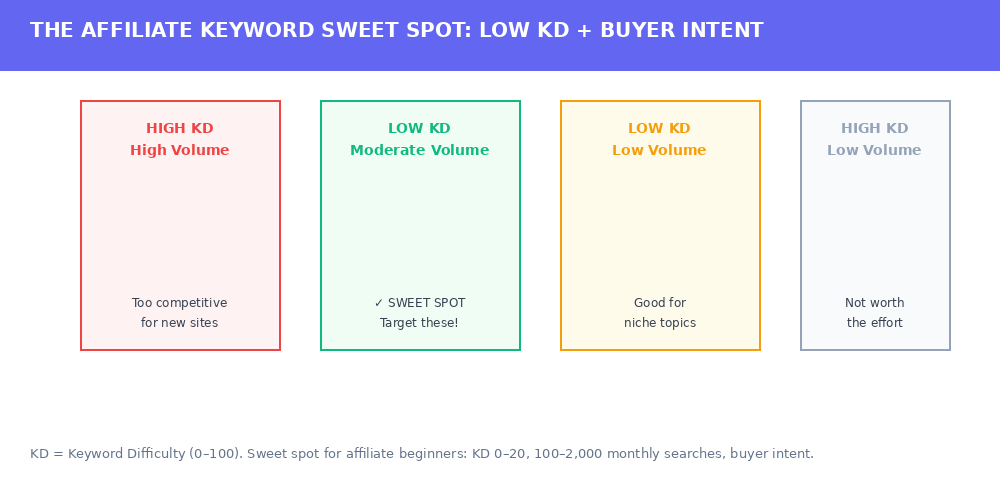
Don’t be fooled by high-volume keywords. A keyword with 50,000 monthly searches and KD 70 is essentially unrankable for a new affiliate site. Meanwhile, a keyword with 300 searches/month and KD 8 targeting buyers can put $200–$500/month in your pocket within 6 months. Volume is vanity — intent and difficulty are reality.
Quick Sweet Spot Checklist
- KD score under 20 (under 10 is even better for brand-new sites)
- Monthly search volume between 100–2,000
- SERP shows at least one result from a DR under 40
- Keyword includes a buyer or comparison modifier
- Affiliate programs exist for the products being searched
Stealing Keywords From Competitors (Ethically)
Competitor keyword research is the fastest way to build a winning content strategy. Instead of guessing what keywords might work, you’re looking at what’s already proven to drive traffic and commissions in your niche.
How to Do It With Ahrefs
- Find 3–5 affiliate sites in your niche that are clearly earning (look for sites with review-heavy content and obvious affiliate links).
- Enter their domain into Ahrefs Site Explorer → go to “Top Pages.”
- Sort by traffic. Look for pages with buyer-intent keywords in the title.
- Filter for keywords where your site doesn’t rank yet — these are your content gaps.
- Prioritize any keyword where the competitor ranks but has a thin, outdated, or poorly optimized post — you can outrank them with better content.
This approach is so powerful because you’re essentially letting your competitors do years of trial-and-error keyword testing, then swooping in with better content. As Neil Patel consistently emphasizes, the fastest-growing content sites are those that learn from competitors, not just from keyword tools.
📌 Related: The Best Affiliate Traffic Strategies: SEO, Pinterest & Email
Watch: Keyword Research for Affiliate Sites in Action
The Ahrefs team is one of the most trusted voices in SEO education. This tutorial walks through the exact keyword research workflow inside Ahrefs — from finding seed keywords to evaluating keyword difficulty and identifying opportunities your competitors are missing.
Similar Posts
Affiliate Site Traffic Drop After a Core Update: The Essential Diagnostic Checklist
A step-by-step checklist to diagnose and recover from an affiliate site traffic drop after a Google core update.
Buyer Intent Keywords for Affiliate Marketing That Sell
I’ve wasted more money chasing traffic that never converts than I care to admit. The breakthrough came when I discovered that buyer intent keywords for affiliate marketing changed everything about how I approached content strategy. Most affiliates obsess over search volume, building content around massive traffic numbers that bring tire-kickers, curiosity-seekers, and people who’ll never…
Keyword Research for Affiliate Marketing: Dominate Low Competition
Master keyword research for affiliate marketing and dominate low-competition niches. Our listicle reveals the insider techniques.
Affiliate Marketing Comparison Template: Write Reviews That Convert Faster
Boost your affiliate marketing with our powerful comparison template. Craft reviews that convert faster with this proven tool.
SEO Checklist (2026): Step-by-Step On-Page + Technical
Optimize your website with this comprehensive SEO checklist for 2026. Boost visibility and rankings with our step-by-step on-page and technical tips.
How to Get Cited in Google AI Overviews as an Affiliate Site
AI Overviews are reshaping search visibility. Here’s how affiliate sites can structure content to actually get cited.