
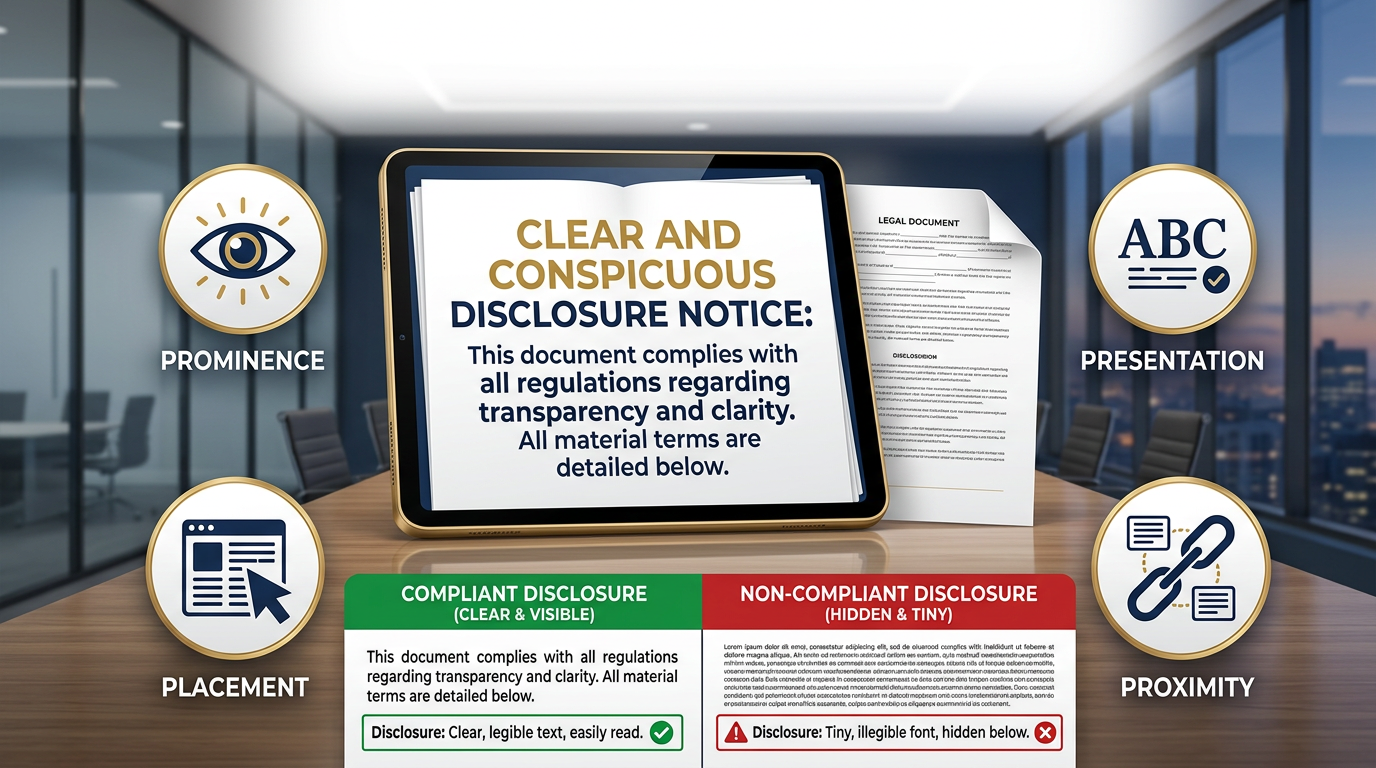
Disclosure: The Critical Four-Factor ‘Clear and Conspicuous’ Test, With Examples
You added the word “affiliate” somewhere on the page, so you figure your disclosure is covered. Except the FTC doesn’t grade disclosures on whether the word exists — it grades them on whether an ordinary reader would actually notice and understand them before making a buying decision. That’s the clear and conspicuous disclosure test, and in 2026 it’s being enforced more actively than most publishers realize.
This guide breaks the test down into the four factors the FTC actually looks at, with concrete examples of what passes and what doesn’t, so you can check your own site against a real standard instead of guessing.
In This Article
Where This Standard Comes From
The FTC’s Endorsement Guides don’t give affiliates a fixed sentence to copy and paste. Instead, they set a functional standard: your disclosure has to be “clear and conspicuous,” meaning easy for an ordinary reader to notice, process, and understand in the context they’re reading. Enforcement has picked up meaningfully, with the FTC sending warning letters and taking action against publishers and networks whose disclosures were technically present but practically invisible.
That distinction — present versus practically invisible — is where most affiliate sites get tripped up. Regulators generally break the standard down into four factors: proximity, prominence, presentation, and placement. A disclosure that fails any one of these can still get flagged, even if the other three are handled well.
Why This Is Getting More Attention Now
For a long time, a lot of affiliate publishers treated disclosure as a box-checking exercise — add a line somewhere, move on. That approach has gotten riskier. Networks and platforms have faced more direct pressure to hold their publishers to the actual standard rather than a loose interpretation of it, and individual sites are more likely to get flagged than they were a few years ago.
None of this means the rules themselves are new. The four-factor framework has existed for a while. What’s changed is how closely it’s being checked, which means disclosures that used to slide by on a technicality are now worth revisiting.
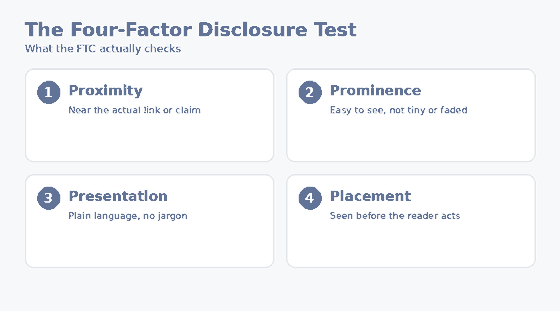
Factor 1: Proximity
Proximity means your disclosure has to sit near the claim or link it’s disclosing, not somewhere disconnected from it. A single disclosure buried in your site footer doesn’t cover a specific affiliate link three scrolls up the page, because a reader encountering that link has no reason to have seen the footer first.
Passes: A short disclosure line at the top of a review, before any affiliate links appear, plus a repeated note near dense link clusters like comparison tables.
Fails: One disclosure statement on a separate “Disclosure” page, linked only from the main navigation, with no mention anywhere near the actual affiliate links in your content.
Factor 2: Prominence
Prominence is about whether the disclosure is actually noticeable — font size, color contrast, and placement relative to surrounding text all matter here. A disclosure in pale gray six-point font blending into your background technically exists but isn’t prominent in any meaningful sense.
Passes: Disclosure text sized and styled similarly to your regular body text, in a color that contrasts clearly against the background, not shrunk down or faded out.
Fails: Disclosure text set several sizes smaller than the surrounding content, or styled in a color close enough to the background that it requires effort to read.
Factor 3: Presentation
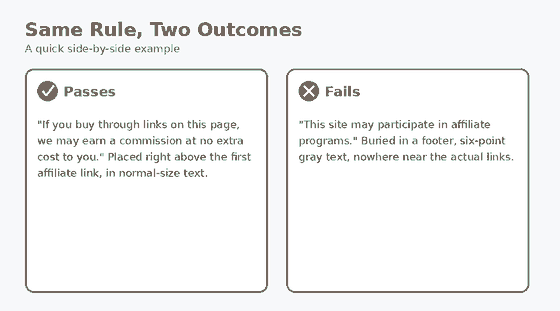
Presentation covers the actual language you use. Vague or jargon-heavy phrasing that a general reader wouldn’t understand doesn’t meet the standard, even if it’s technically accurate. Terms like “affiliate relationship” or “commercial relationship” without further explanation can be too abstract for an average reader to connect to “this site earns money when you click this link.”
Passes: Plain language along the lines of “If you buy through links on this page, we may earn a commission at no extra cost to you.”
Fails: Legal-sounding phrasing like “This site may participate in affiliate programs” with no explanation of what that means for the reader’s wallet or experience.
Factor 4: Placement
Placement is about where in the reading experience the disclosure sits, relative to when the reader encounters the affiliate content. A disclosure the reader has to scroll far past, click through, or find on a separate page before reaching the relevant content generally doesn’t satisfy this factor, especially on mobile where scrolling behavior differs from desktop.
Passes: Disclosure visible before or alongside the first affiliate link a reader encounters, without requiring extra clicks or significant scrolling to find it.
Fails: Disclosure that only appears after a “Read More” click, or that’s placed at the very bottom of a long article after all the affiliate links have already been shown.
A Quick Way to Self-Audit
Pull up one of your own affiliate posts on both desktop and mobile and ask, honestly, whether a first-time visitor would notice the disclosure before clicking an affiliate link — not whether the disclosure exists somewhere on the page. If you have to search for it, or if it only shows up once at the very top of a long piece with dozens of links below, it’s worth tightening.
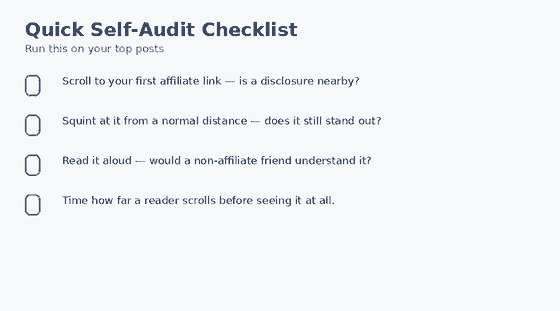
A dedicated affiliate disclaimer page is still useful as a reference and a good place to link to for full detail, but it should support your in-content disclosures, not replace them. Go through this in order for a handful of your top posts: check proximity by scrolling to your first affiliate link and looking for a disclosure nearby.
Check prominence by squinting at the text from a normal viewing distance to see if it actually stands out, check presentation by reading the wording out loud and asking whether a non-affiliate friend would understand it, and check placement by timing how far a reader scrolls or clicks before hitting a disclosure relative to the first affiliate mention.
Doing this for even five or six of your highest-traffic posts will usually surface the same one or two habits repeated across your whole site, which makes fixing them site-wide much faster than treating each post as a one-off problem.
Frequently Asked Questions
Is one disclosure statement per page enough?
It depends on the page. For a short post with a handful of links near the top, one clear disclosure near those links may be enough. For long comparison posts or listicles with links scattered throughout, repeating the disclosure near dense link clusters is safer and more aligned with the proximity factor.
Does a disclosure in my site footer count?
Generally no, on its own. A footer disclosure can be a helpful backup, but it doesn’t satisfy proximity or placement for links that appear far from the footer, especially above the fold or early in an article.
What about disclosures on social platforms like Pinterest or TikTok?
The same four factors apply, but the mechanics differ by platform, and the FTC has published specific guidance for social media disclosures. A disclosure buried in a caption below a “see more” cutoff, or one that requires clicking through to a bio link, generally fails placement and prominence even if the wording itself is fine.
Do I need a lawyer to review my disclosures?
Not necessarily for a basic self-audit, but if you’re running a larger site or network with real revenue at stake, a quick professional review is a reasonable precaution given how actively this area is being enforced right now.
Closing Thoughts
The four-factor test isn’t complicated once you break it apart, but it does require actually looking at your content the way a first-time reader would, not the way you know it’s structured. Get proximity, prominence, presentation, and placement right, and you’re covering the standard regulators actually apply, not just the letter of having a disclosure somewhere on your site.