
Beginner Affiliate Networks Explained the Smart Way
If you’ve ever Googled beginner affiliate networks explained, you’ve probably drowned in a sea of recycled advice that reads like it was written by someone who’s never actually earned a commission. Here’s the problem: most guides treat you like you can’t handle the truth. They gloss over the parts that actually matter — like why you keep getting rejected from networks, why your first commissions will be embarrassingly small, and why picking the wrong network can waste six months of your life. I’ve spent over a decade in affiliate marketing, managed seven-figure campaigns, and made every rookie mistake you can imagine. This guide is the one I wish I’d had when I started. Let’s fix your strategy.
Table of Contents
- What Are Affiliate Networks, Really?
- Affiliate Network vs. Affiliate Program: The Difference That Matters
- The Best Beginner Affiliate Networks (And Why)
- 3 Myths About Beginner Affiliate Marketing I Need to Kill
- How to Actually Get Accepted (Insider Tactics)
- Choosing Your First Offers: The Framework I Use
- Compliance Mistakes That Get Beginners Banned
- Advanced Beginner Tactics for Faster Results
- FAQ
- My Top Recommended Gear
What Are Affiliate Networks, Really?
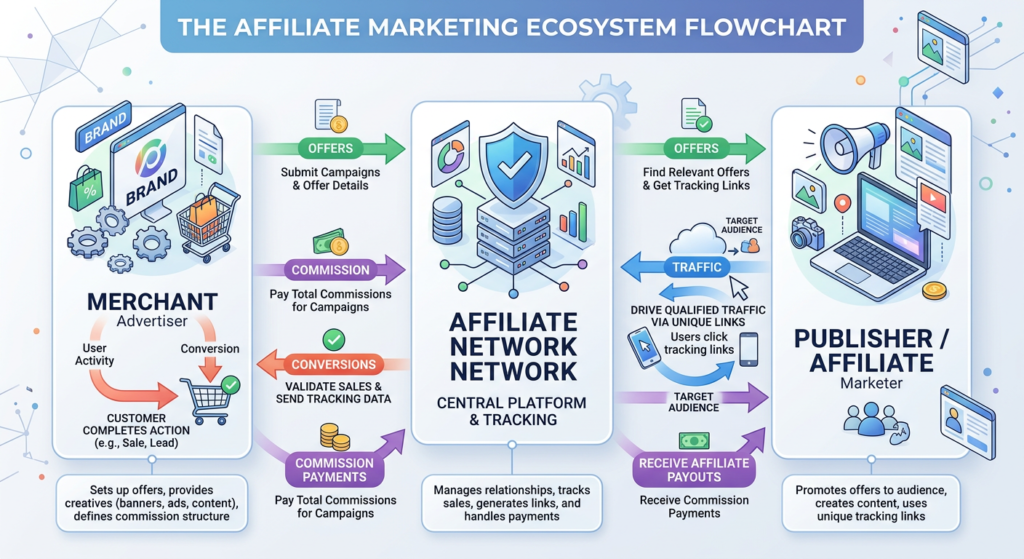
An affiliate network is a middleman platform that connects publishers (you) with merchants (brands) who want to pay commissions for sales, leads, or clicks. The network handles tracking, reporting, and payments so neither party has to build that infrastructure from scratch. Think of it as a marketplace for monetization opportunities.
That’s the textbook definition. But here’s what I actually want you to understand: affiliate networks exist because trust is expensive. A merchant doesn’t know you. You don’t know them. The network vouches for both sides, tracks every click with military precision, and makes sure everyone gets paid. Without networks, you’d be emailing random companies begging for a partnership and hoping they don’t ghost you. (Spoiler: they would.)
The Federal Trade Commission (FTC) requires affiliates to disclose their relationships with merchants, and legitimate networks build compliance tools directly into their platforms. This isn’t optional — it’s the law. I bring this up now because understanding the regulatory framework from day one separates serious affiliates from hobbyists who get their accounts shut down.
Affiliate Network vs. Affiliate Program: The Difference That Matters
I see beginners confuse these constantly, and it costs them time and money. Let me make this dead simple:
- Affiliate Program: A single company (like Shopify or Bluehost) runs its own referral system. You apply directly to them. One brand, one dashboard, one relationship.
- Affiliate Network: A platform like ShareASale, CJ Affiliate, or Awin that hosts thousands of individual affiliate programs. One application gets you access to a massive catalog of merchants.
Why does this matter for you as a beginner? Because networks give you leverage. Instead of applying to 50 different brands individually and managing 50 different logins, tracking systems, and payment schedules, you manage everything from one dashboard. I compared some of the biggest options in my breakdown of Amazon vs. ClickBank vs. partner programs — it’s worth reading if you’re trying to decide which model fits your niche.
The Best Beginner Affiliate Networks (And Why)
I’m not going to list 25 networks and pretend they’re all equal. Here are the ones I actually recommend for someone just starting out, based on ease of acceptance, payout reliability, and offer quality:
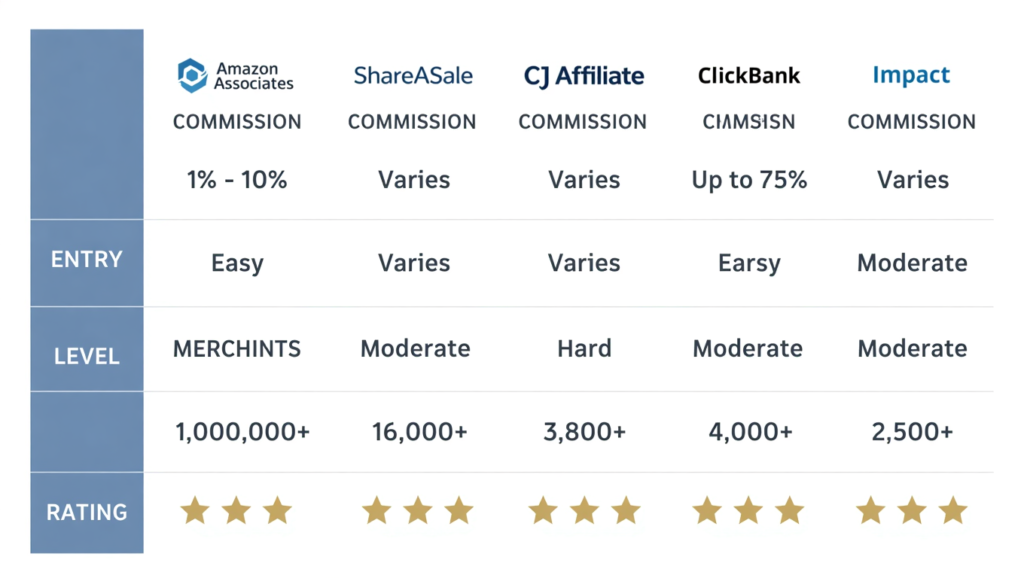
- Amazon Associates: The gateway drug of affiliate marketing. Commissions are low (1-10%), but the conversion rate is insane because everyone trusts Amazon. Perfect for product review sites and content-heavy blogs.
- ShareASale: My personal favorite for beginners who want variety. Over 4,500 merchants across every niche imaginable. Their interface is a bit dated, but the reliability is unmatched.
- CJ Affiliate (Commission Junction): Higher-tier brands, slightly harder to get accepted by individual merchants, but excellent for affiliates who want to grow into premium partnerships.
- ClickBank: Digital products with insanely high commissions (50-75%). The quality of products varies wildly — you need to vet everything before promoting. But when you find a winner, the payouts are life-changing.
- Impact: Modern platform with great tracking tech. Hosts brands like Uber, Airbnb, and Canva. Acceptance depends on the individual brand’s requirements.
For a more detailed comparison with my honest ratings, check out my full guide on the best affiliate networks for beginners.
3 Myths About Beginner Affiliate Marketing I Need to Kill
Myth #1: “You need tons of traffic to make money.” No, you don’t. I’ve seen affiliates earning $2,000/month from sites with 5,000 monthly visitors. The secret? High buyer intent keywords and premium affiliate programs with strong EPCs (earnings per click). Volume is one lever; conversion optimization is another. According to research from the Pew Research Center, consumer trust in online recommendations continues to grow — which means even small, authoritative sites can convert at impressive rates.
Myth #2: “Passive income means zero effort.” Let’s be real here. Passive income through affiliate marketing requires massive upfront effort. I spent 8+ months building my first site before I saw consistent commissions. The “passive” part comes later, once your content ranks and compounds. Anyone selling you overnight riches is lying. Period.
Myth #3: “More affiliate networks = more money.” Actually, spreading yourself across 10 networks as a beginner is a recipe for burnout. I recommend mastering one or two networks first, understanding their tools and merchant relationships, and then expanding. Depth beats breadth every time when you’re starting out.
How to Actually Get Accepted (Insider Tactics)
Here’s something most guides won’t tell you: affiliate networks reject applications all the time, and they rarely tell you exactly why. After years of working on both sides of the table, I know what compliance teams look for. IMO, this is where 90% of beginners fail before they even start.
- Have a real website with real content. A blank WordPress install with “Coming Soon” on the homepage will get you rejected instantly. Publish at least 10-15 quality articles before applying.
- Fill out your application completely. Sounds obvious, right? You’d be shocked how many people leave the “how will you promote our products” field blank or write one word.
- Be specific about your traffic sources. Say “SEO-focused blog content targeting product comparison keywords in the home fitness niche” instead of “social media and stuff.”
- Don’t lie about your traffic numbers. Networks can verify this. Overstating your stats is the fastest way to get blacklisted.
The Australian Government’s digital marketing resource offers excellent general guidance on ethical online marketing practices that align well with what networks expect from publishers.
Choosing Your First Offers: The Framework I Use
When I evaluate an offer on any beginner affiliate network, I run it through what I call the “TRCP” framework:
- T — Trust: Would I personally buy this product? If the answer is no, I don’t promote it. Your reputation is your most valuable asset.
- R — Relevance: Does this product genuinely solve a problem for my specific audience? Promoting web hosting on a cooking blog is a waste of everyone’s time.
- C — Commission Structure: I look at EPC (earnings per click), cookie duration, and whether they offer recurring commissions. A $5 one-time payout on a product nobody buys is worthless compared to a $20/month recurring commission.
- P — Proof: I check for social proof, merchant reviews, and refund rates. A merchant with a 30% refund rate will claw back your commissions and destroy your earnings.
Expert Commentary: This video provides one of the clearest breakdowns of how affiliate marketing works from a practical standpoint — I recommend it because it skips the hype and focuses on the mechanics that actually drive commissions.
Compliance Mistakes That Get Beginners Banned
This is the section nobody wants to write but everyone needs to read. I’ve seen talented affiliates lose thousands in earned commissions because they ignored basic compliance rules. Here are the big ones 🙂
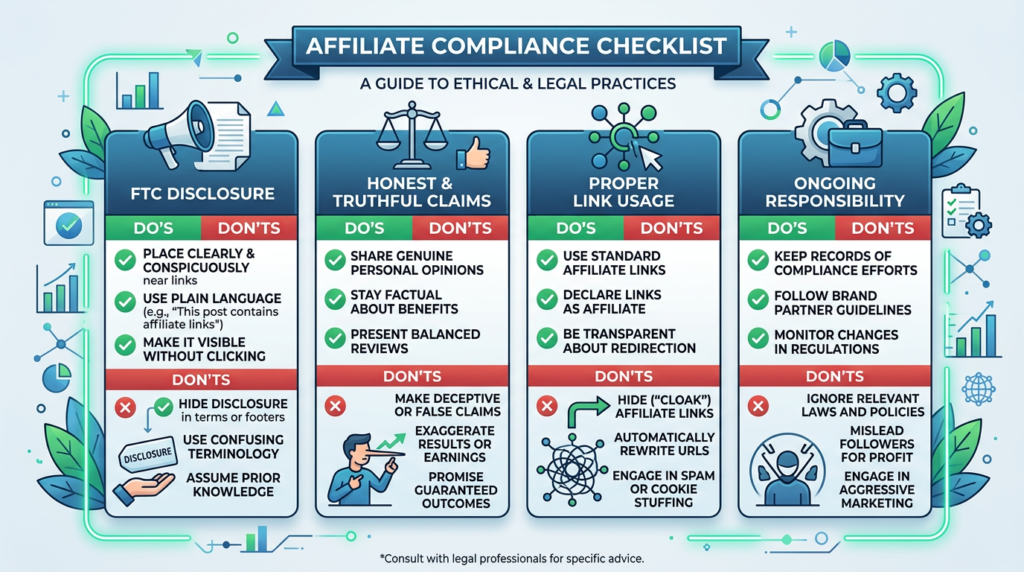
- Not disclosing affiliate relationships: The FTC requires clear, conspicuous disclosure. “This post contains affiliate links” buried in your footer doesn’t cut it. Put it near the links themselves.
- Making income claims without proof: Saying “I made $10,000 last month with this product” when you didn’t is fraud. Full stop.
- Cookie stuffing or incentivized clicks: Offering rewards for clicking your affiliate links violates virtually every network’s terms of service. Don’t even think about it.
- Using brand names in paid search ads: Many merchants explicitly prohibit bidding on their brand terms in Google Ads. Violate this and you’ll get booted immediately.
I wrote an entire deep-dive on networks compliance that covers the legal nuances in much more detail. If you’re serious about building a sustainable affiliate business, that article is mandatory reading.
Advanced Beginner Tactics for Faster Results
You’ve picked your network. You’ve been accepted. You’ve chosen solid offers. Now what? Here are the affiliate tips I give to every person I mentor — the tactics that separate affiliates who earn beer money from those who build real income streams:
- Build comparison content first. “Product A vs. Product B” articles convert at 2-3x the rate of standard reviews. Why? Because the reader has already decided to buy — they’re just deciding which one. That’s bottom-of-funnel gold.
- Track everything from day one. Use sub-IDs in your affiliate links to track which pages, which buttons, and which calls-to-action drive conversions. If you’re not tracking, you’re guessing. And guessing doesn’t scale.
- Email is your insurance policy. Social algorithms change. Google updates hit. But your email list? That’s yours forever. Start building it immediately, even before you think you’re “ready.”
- Negotiate higher commissions early. Once you send a merchant even 10-20 sales, reach out and ask for a rate bump. Most beginners never do this. Most merchants will say yes. This one move increased my earnings by 40% in my second year.
A study from the Harvard Business Review reinforces what I’ve seen anecdotally: authentic, trust-based content marketing consistently outperforms aggressive sales tactics. Build trust first, and commissions follow naturally. TBH, that’s the only sustainable strategy I’ve ever seen work long-term.
Frequently Asked Questions
What is the easiest affiliate network for beginners?
Amazon Associates is widely considered the easiest affiliate network for beginners due to its low barrier to entry, massive product catalog, and trusted brand recognition. However, commission rates are relatively low (1-10%), so many beginners also explore ShareASale or CJ Affiliate for higher-paying offers once they gain confidence.
How much money can a beginner make with affiliate marketing?
Most beginners earn between $0 and $500 per month in their first 6-12 months. Realistic expectations matter — beginner affiliate marketing is not a get-rich-quick scheme. With consistent effort, quality content, and smart network selection, many affiliates scale to $1,000-$5,000 per month within 18-24 months.
Do I need a website to join an affiliate network?
Most reputable affiliate networks require a website, blog, or established social media presence. Some networks like Amazon Associates accept YouTube channels or social media accounts. Having your own website gives you the most control and credibility when applying to affiliate programs.
What is the difference between an affiliate network and an affiliate program?
An affiliate program is run directly by a single company (like Bluehost or Shopify). An affiliate network is a marketplace that hosts hundreds or thousands of affiliate programs from different merchants under one platform, making it easier to find, join, and manage multiple offers in one dashboard.
My Top Recommended Gear
Whether you’re building your first affiliate site or scaling an existing one, these are the tools I personally use and recommend. Good tools won’t replace good strategy, but they sure make execution a lot smoother:
- Ahrefs SEO Toolkit: The single most important investment for any affiliate marketer serious about organic traffic. Keyword research, competitor analysis, backlink tracking — it does everything. Browse Ahrefs SEO resources on Amazon
- Logitech MX Keys Keyboard: When you’re writing 3,000+ words per day, your keyboard matters. I’ve used this one for three years and my wrists have never been happier. Check Logitech MX Keys on Amazon
- Blue Yeti USB Microphone: If you’re creating YouTube content or podcast episodes to support your affiliate content (and you should be), this microphone delivers studio-quality audio without the studio price tag. Find Blue Yeti Microphone on Amazon
Disclaimer: This post contains affiliate links. As an Amazon Associate, I may earn a commission from qualifying purchases at no additional cost to you.