
Powerful: How Many Articles Before Affiliate Site Ranks? The Real Answer
Disclosure: Some links on this page may be affiliate links. If you buy through them, I may earn a commission at no extra cost to you. I only recommend what I’d use myself. Read the full disclosure.
The question I hear most from new bloggers is simple: how many articles before affiliate site ranks — as if a magic number flips a switch and Google suddenly notices you exist. I get it. You’ve been publishing for weeks, maybe months, and your traffic chart looks like a flat desert road. So you start counting posts, wondering whether 30 is the threshold. Or 50. Or 100.
Here’s the pattern interrupt: according to Ahrefs’ 2025 analysis of millions of URLs, only about 1.74% of newly published pages reach Google’s top 10 within a year. Article count didn’t rescue the other 98%. Volume has never been the lever that moves rankings — and once you understand what actually is, you stop pouring months into invisible content and start building a site that genuinely climbs.
Table of Contents
- Why “How Many Articles” Is the Wrong Question
- What Actually Triggers Rankings (Hint: Not Volume)
- The Diagnostic Checklist: Why Your Site Isn’t Ranking Yet
- The Myth That Keeps Affiliate Bloggers Broke
- The Advanced Move: Topic Clusters Beat Raw Volume
- So, How Many Articles Do You Actually Need?
- Frequently Asked Questions
- My Top Recommended Gear
Why “How Many Articles” Is the Wrong Question
There is no fixed number of articles before an affiliate site ranks. Rankings depend on indexing, topical coverage, content quality, internal links, and site trust — not raw post count. Most new affiliate sites see real movement in three to six months once those signals align, whether the site has 15 posts or 150.
Post count is a vanity metric. It feels productive because it’s easy to measure — you can watch the number tick up. But Google doesn’t reward you for hitting 50 published URLs any more than a gym rewards you for owning 50 dumbbells you never lift. What ranks is the quality and structure of what you’ve published, plus the trust your domain has earned over time.
I’ve audited affiliate sites with 200+ posts that couldn’t crack page five, and I’ve watched lean 20-article sites dominate their niche inside a year. The difference was never the count. It was whether the owner nailed the fundamentals of affiliate SEO before scaling. So what’s the real number you should aim for? Hold that thought — I’ll give you concrete ranges near the end, once the pieces make sense.
What Actually Triggers Rankings (Hint: Not Volume)
If article count isn’t the trigger, what is? Rankings come from a handful of signals working together. Miss any one of them and you can publish forever without moving.
Does Google even know your articles exist?
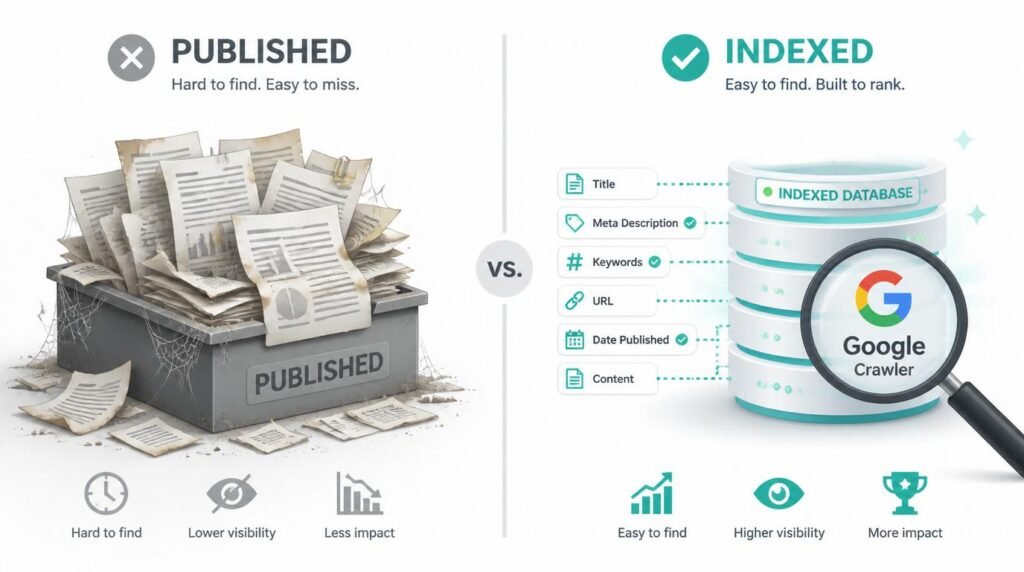
This one embarrasses more site owners than any other. You can’t rank a page Google hasn’t indexed — and publishing is not the same as indexing. New sites frequently have half their posts sitting in Search Console limbo, discovered but not crawled, or crawled but not indexed. Before you write a single new post, open Google’s own documentation on how Search works and confirm your existing pages are actually in the index. If they’re not, no amount of new content fixes the leak.
Are you covering the whole topic, or just poking at it?
Google rewards sites that demonstrate genuine authority on a subject — what the industry calls topical authority. Ten scattered articles about ten unrelated products signal nothing. Ten articles that fully answer every question a buyer has about one product category signal expertise. This is exactly why proper keyword research for affiliate sites matters more than a content quota: it tells you which cluster of topics to own completely instead of dabbling everywhere.
Is your content actually better than what’s on page one?
Ranking is competitive by definition. To take a spot, you have to be more relevant, more helpful, or more trustworthy than the pages already there. Google spells this out plainly in its guidance on creating helpful, people-first content. If your review reads like a rewritten spec sheet while the top result includes hands-on testing, original photos, and honest downsides, more articles won’t close that gap — better ones will. Weighting your library toward buyer-intent keywords also means the pages you do rank are the ones that actually pay.
The Diagnostic Checklist: Why Your Site Isn’t Ranking Yet
Feeling stuck? Instead of asking how many more posts to write, run your site through this diagnostic. Nine times out of ten, the real bottleneck is hiding in one of these five buckets.
- Indexing. Are your pages in Google’s index, not just live on your server? Check Search Console coverage and run a site:yourdomain.com search. Un-indexed pages have a zero percent chance of ranking, full stop.
- Topical coverage. Do your articles form a complete cluster around one clear subject, or are they scattered across unrelated topics? Gaps in coverage tell Google you’re not the authority — and authority is what gets rewarded.
- Internal links. Does every new post receive descriptive internal links from three to five relevant existing pages? Internal linking is the single most controllable lever you have to pass authority and help Google understand your structure.
- Content quality. Does each page beat the current top ten, or merely match them? Match the search intent, then exceed it with real experience, data, and specifics. Nail the fundamentals of affiliate SEO here and everything else compounds.
- Site age and trust. Is your domain simply too young? Google’s John Mueller has said it can take up to a year for Google to work out where a brand-new site belongs. That waiting period is real and no post count shortcuts it.
The Myth That Keeps Affiliate Bloggers Broke
Want to know the single most expensive myth in affiliate marketing? It’s the belief that “if I just publish 100 articles, the rankings will come.” I’ve watched people burn a year and a small fortune on writers chasing that number, only to end up with a hundred indexed-but-invisible pages.
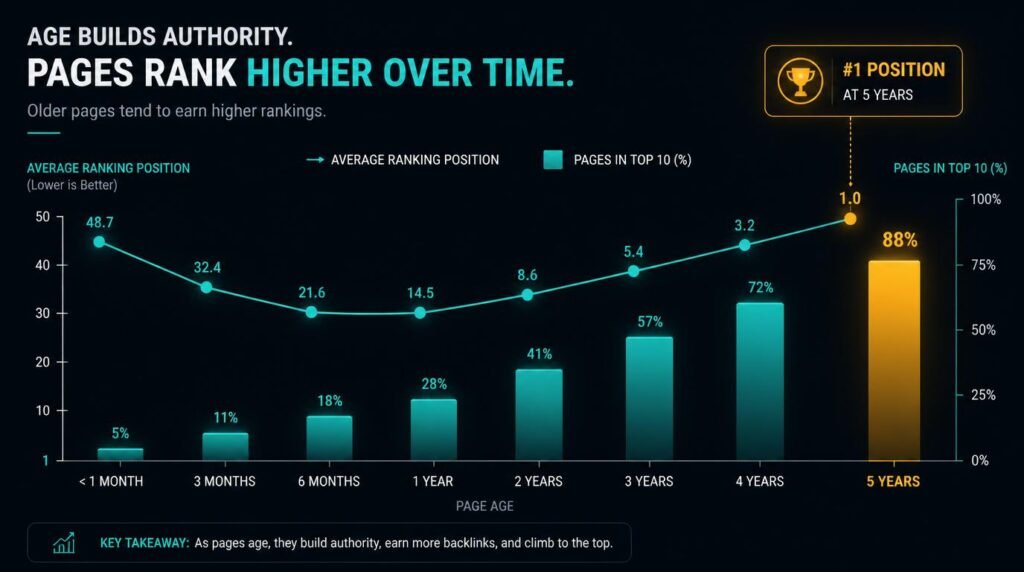
The data dismantles this myth cleanly. Ahrefs found that the average page sitting at position #1 is now roughly five years old, and about 72.9% of top-ten pages are more than three years old. Meanwhile, as covered in Ahrefs’ breakdown of how long SEO really takes, most sites need three to six months just to see the first flickers of movement. Age, trust, and links do the heavy lifting — and none of those come from volume alone.
If you’ve published 40 posts and you’re staring at a flat traffic graph right now, hear this: you are not failing because you didn’t write enough. You’re early, and early is not the same as wrong. ngl, that flat-line phase broke my spirit the first time too — right up until I stopped counting posts and started fixing signals. The moment you shift from “how many” to “how good and how connected,” the whole game changes.
Expert Commentary: This Ahrefs breakdown is worth ten minutes because it walks through the exact 2-million-page dataset behind these timelines and translates it into a repeatable strategy — targeting lower-competition, high-intent keywords first — that’s directly applicable to a new affiliate site trying to earn its first rankings.
The Advanced Move: Topic Clusters Beat Raw Volume
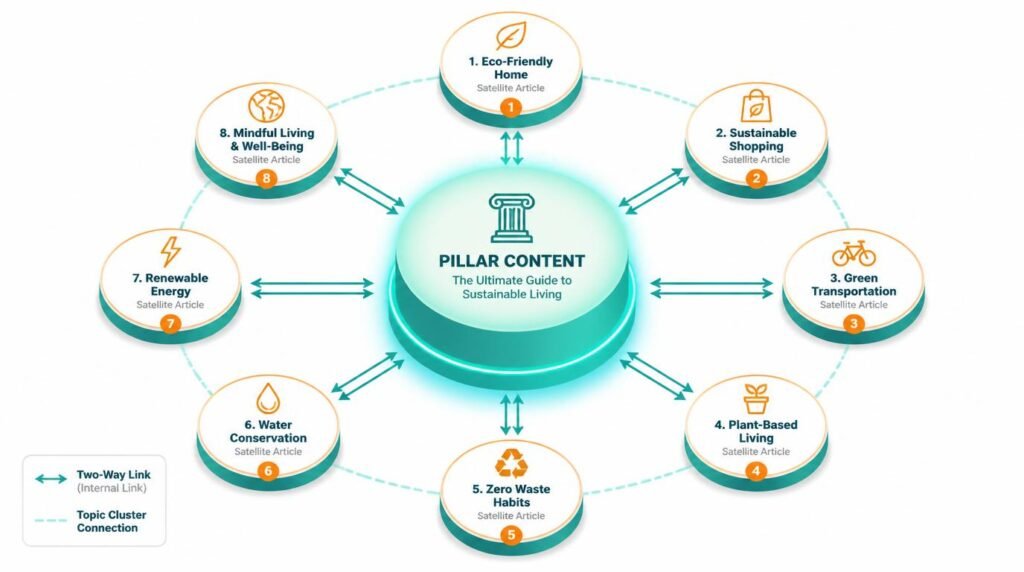
Here’s the insider move most beginner guides won’t tell you: Google doesn’t rank isolated articles nearly as well as it ranks interconnected ones. The pros build topic clusters — a central pillar page targeting a broad head term, surrounded by supporting posts that each answer a specific sub-question and link back to the pillar.
Structured this way, 20 tightly-linked articles can out-punch 80 orphaned ones. Each supporting post reinforces the pillar’s authority, and the internal links spread ranking equity across the whole cluster. When you publish something new, immediately wire it into the cluster with three to five contextual internal links from existing pages — it’s the fastest, most controllable ranking accelerator you have.
TBH, this is where article count and rankings finally reconnect: the number that matters isn’t total posts, it’s how completely your posts cover a single, monetizable topic. A finished cluster tells Google “this site is the resource for X.” A random pile of 100 posts just says “this site publishes a lot.”
So, How Many Articles Before Affiliate Site Ranks Do You Actually Need?
I promised real numbers, so here they are — with the crucial caveat that these are cluster sizes, not vanity counts. For a tight micro-niche, 20 to 30 well-structured, fully-interlinked articles can be enough to rank and earn, often within three to six months on a domain that’s building trust. For a broader niche, plan on 50 to 100+ posts, but built as several complete clusters rather than one sprawling mess.
Competitive money niches (think finance, health, or high-ticket tech) typically demand six to twelve months of sustained effort plus real backlinks before the top ten opens up. New domains carry the extra tax of the trust-building period, so patience isn’t optional — it’s part of the plan. Aim for completeness over count, weight your library toward buyer intent, keep everything indexed and interlinked, and the rankings follow. Play it that way and the “how many articles” question quietly answers itself. 🙂
Frequently Asked Questions
How long does it take for a new affiliate site to rank on Google?
Most new affiliate sites start seeing meaningful movement in three to six months, and competitive niches can take six to twelve months or longer. Google’s John Mueller has said it can take up to a year for Google to figure out where to rank a new site — what SEOs call the sandbox effect.
Can an affiliate site rank with only 10 or 20 articles?
Yes. A tightly focused site with 15 to 25 high-quality, well-interlinked articles that fully cover a narrow topic can outrank a bloated site with hundreds of thin posts. Coverage and quality beat raw count every time.
Do I need to publish articles every day to rank faster?
No. Publishing frequency matters far less than topical completeness and quality. A steady, sustainable schedule of strong, interconnected posts outperforms a daily flood of shallow content that Google may never even index.
Why isn’t my affiliate site ranking even after 50 posts?
Usually one of five reasons: your pages aren’t indexed, your posts don’t form a complete topic cluster, your internal linking is weak, your content doesn’t beat page one, or your domain is still too new to be trusted. Article count is rarely the actual problem.
How many articles should I publish before expecting affiliate commissions?
Focus on buyer-intent content rather than a target number. A cluster of 20 to 40 articles that includes solid review and comparison posts around a single niche is a realistic foundation for first commissions — assuming the pages rank and match purchase intent.
My Top Recommended Gear
- The Art of SEO (Enge, Spencer & Stricchiola) — The most thorough desk reference I keep within reach; it grounds every ranking decision in fundamentals instead of hacks.
- They Ask, You Answer (Marcus Sheridan) — The clearest framework I’ve found for building buyer-intent topic clusters that actually convert readers into commissions.
- Blue-Light Blocking Glasses — Unglamorous but essential; these saved my eyes during the long editing marathons that quality content actually requires.
Disclaimer: This post contains affiliate links. As an Amazon Associate, I may earn a commission from qualifying purchases at no additional cost to you. I only recommend products I’ve personally tested or rigorously researched.
Niche → offer → SEO cluster → Pinterest pins → first clicks. No fluff.